Classroom Presenter Using the Tablet PC to support Classroom Interaction
180 likes | 315 Vues
This presentation explores the transformative role of Tablet PCs in university classrooms. Richard Anderson from the University of Washington discusses how computational devices—like laptops, tablets, and smartphones—can enhance classroom interaction when fully integrated into instruction. The application of these devices can facilitate presentations, simulations, note-taking, and peer communication, promoting active learning and engagement. With a focus on pedagogy, the discussion emphasizes the importance of electronic interaction in supporting diverse student contributions and achieving educational goals.


Classroom Presenter Using the Tablet PC to support Classroom Interaction
E N D
Presentation Transcript
Classroom PresenterUsing the Tablet PC to support Classroom Interaction Richard Anderson University of Washington June 14, 2006
What will the university classroom look like . . . • If all students have computational devices • Laptops, Tablets, Ultralight Tablets, PDAs, Smart Phones, Gameboys . . . • If the devices are all connected • If the devices are integrated into classroom instruction
Wide range of potential classroom applications • Presentation • Demonstration • Simulation • Accessing external resources • Note taking • Feedback • Active learning • Peer communication
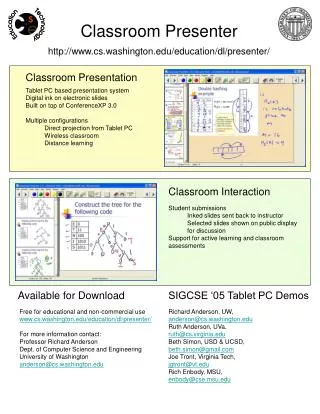
Classroom Presenter • Tablet PC Based Presentation System • Initially developed at MSR (2001-2002) • Continued development at University of Washington • Built on ConferenceXP Research Platform • Ink Based Presentation • Distributed Classroom • Classroom Interaction
Classroom Interaction • Provide additional interaction channels for students • Use these to achieve specific pedagogical goals in class • Why electronic interaction? • Bandwidth – more students can contribute • Expressiveness • Simultaneous • Anonymous • Persistent
Pedagogical Goals • Encourage students to contribute in multiple ways • Promote engagement in the class • Interest • Alertness • Demonstrate that all students have important opinions • Peer interaction
Pedagogical goals • Feedback – classroom assessment • Collection of ideas • Collective brainstorm • Student generation of examples • Discovery of a pedagogical point • Gain understanding of an example • Show misconceptions
Student Attention vs. Time Attention 10 20 30 40 50 60 Time
Problem Solving • You have three coins: • One coin with two heads, one coin with two tails, and one coin with a head and a tail • Suppose you choose a coin at random, flip it in the air and it lands heads. • What is the probability that it’s other side is a head? ?
What concerns would you have about using Tablet PCs in the Classroom?
CLASSROOM PRESENTER www.cs.washington.edu/education/dl/presenter For more information, contact Richard Anderson anderson@cs.washington.edu