Understanding the Central Nervous System: Structure, Function, and Drug Influences
This overview explores the Central Nervous System (CNS), its structures, and its role in our responses to danger, behavioral processes, and biological functions. Highlighting the brain's key parts, including the cerebrum and spinal cord, the text details the protective layers and functions of the CNS. Additionally, it discusses how various drugs—including stimulants, depressants, and opiates—affect synapses and influence alertness, anxiety, and pain relief. Understanding these elements is essential for grasping how our nervous system functions and responds to stimuli.

Understanding the Central Nervous System: Structure, Function, and Drug Influences
E N D
Presentation Transcript
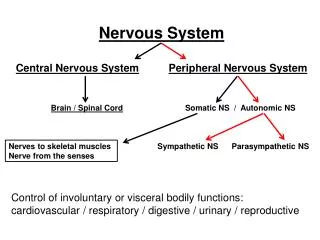
Your Nervous System Central Nervous System
Biology and Behaviour • What behavioural and biological processes are occurring when faced with a danger such as seen in the previous slide?
ExplainCNS • Relays messages • Processes information • Analyzes information
Parts of CNS • The Spinal Cord • The Brain
Protections • Skull and Vertebrae • 3 protective layers called meninges • Dura Mater (outer layer): consists of connective tissues, blood vessels, and nerves. • Arachnoid Layer (middle layer): elastic and weblike • Pia Mater (inner layer): contains nerves and blood vessels. • Cerebrospinal fluid • a clear watery liquid • separates the middle and inner layers • Acts as shock absorber • exchange of nutrients between blood and nervous system
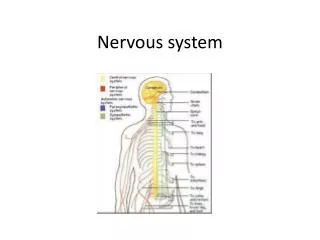
Cerebrum Thalamus Pineal gland Hypothalamus Cerebellum Pituitary gland Pons Medulla oblongata Spinal cord Section 35-3
The Brain • The brain is the controlcenter of the body • It is about 2% of your body weight and uses 20% of your body’s oxygen
Parts of the Brain • Divided into three parts • Cerebrum • Cerebellum • Brain Stem
Cerebrum • Largest part of the brain – Learning and Senses • 2 hemispheres- Right and Left • Connected by the Corpus Callosum • Right side controls- left side • Left side controls – right side of body • Four sections - LOBES 1. Frontal Lobe 2. Parietal Lobe 3. Occipital Lobe 4.Temporal Lobe
Gray Matter vs. White Matter • Gray Matter – Absence of myelin in masses of neurons accounts for the gray matter of the brain – Cerebral Cortex • White Matter - Myelinated neurons gives neurons a white appearance – inner layer of cerebrum
Cerebellum • Second largest • located below the cerebrum at back of skull • This part is responsible for the balance and muscle coordination
Brain Stem • Connects the brain tospinal cord • The Two Regions act as “switchboard” • Medulla Oblongata – Controls heart rate, breathing rate, and flow of blood through the blood vessels. • Pons – Relays signals between the cerebrum and the cerebellum
Other Structures inside the Brain • Thalamus – receives messages from sensory receptors; relays information to proper regions of cerebrum • Hypothalamus - Regulates hunger, thirst, fatigue, anger, etc… • Control of pituitary for endocrine function
Cerebrum Thalamus Pineal gland Hypothalamus Cerebellum Pituitary gland Pons Medulla oblongata Spinal cord Section 35-3
Spinal Cord • Link between brain and rest of body (PNS) • 31 pairs of spinal nerves • Reflexes processed directly by spinal cord • Reflex – quick, automatic, unconscious responses • Result of reflex arcs – shortest nerve pathways
Section 35-5 Used to increase alertness, relieve fatigue Used to relieve anxiety, irritability, tension Used to relieve pain Stimulants Depressants Opiates Amphetamines Barbiturates Tranquilizers Morphine Codeine Increase heart and respiratory rates; elevate blood pressure; dilate pupils; decrease appetite Slow down the actions of the central nervous system; small amounts cause calmness and relaxation; larger amounts cause slurred speech and impaired judgement Act as a depressant; cause drowsiness, restlessness, nausea Drug Type Medical Use Examples Effects on the body
1. Stimulants • Increase • Heart rate • Blood pressure • Breathing • Release of neurotransmitters at some synapses in the brain • Deplete neurotransmitters and lead to: • Fatigue • Circulatory problems • Hallucinations • Depression
2. Depressants • Decrease • Heart rate • Breathing rate • Blood pressure • Relax muscles • Relieve tension • Enhances release of neurotransmitters that prevent nerves cells from firing • Alcohol with depressants can lead to death – depresses CNS to a point one stops breathing