Download
1 / 7
70 likes | 189 Vues
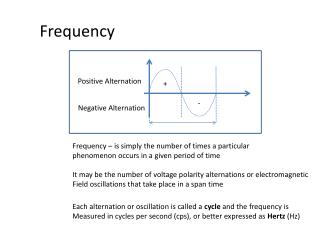
In physics, frequency calculations are crucial for understanding wave behavior. By using simple equations, we can determine the frequency of a wave by dividing the number of waves by the time taken for their occurrence. For example, if 5 complete waves are produced in 0.1 seconds, we can easily find the frequency. This guide also includes examples and questions to practice, such as calculating the number of waves when the frequency is known. Mastering these calculations is essential for confident mathematicians and physicists alike.

E N D
Calculations using Equations • In Physics, we often have to do calculations. • We use equations like the one opposite. • To calculate the frequency of a wave you have to divide the number of waves by the time they take.
crest trough Counting the Waves The diagram below shows one complete wave. It has a crest and a trough. Question : How many waves are shown in this diagram? The answer is 5 complete waves.
Doing the sum • Suppose that the 5 waves in the previous slide were made in 0.1 seconds. • To calculate the frequency, we do the sum below.
Here’s one for you to try Question : Calculate the frequency of these waves if they took 0.2 seconds to produce. Answer
For confident mathematicians To save writing, we often shorten our equations like this. Can you work out what this means? f stands for frequency Nw stands for the number of waves t stands for the time
Calculating the number of waves Sometimes, we are told what the frequency of a wave is and we have to calculate the number of waves. Then we have to change our equation round. Example : When you play the note low C on a key board, the frequency of the note is 262 hertz. If it lasts for 3 seconds, how many waves are produced ?