Download
1 / 45
450 likes | 553 Vues
This educational material explores oxidation and reduction (redox) reactions, detailing their significance in various chemical processes including batteries, combustion, and photosynthesis. It describes key concepts such as the transfer of electrons, oxidation states, and the distinctions between oxidation and reduction. Real-world applications are discussed, such as in fuel cells and the process of rusting. Developed as part of the Australian School Innovation in Science, Technology, and Mathematics project, this resource is valuable for students and educators in understanding the fundamentals of redox chemistry.

E N D
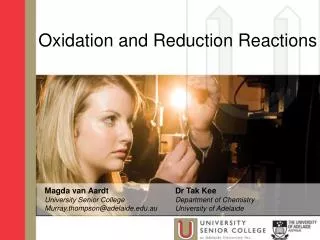
Oxidation and Reduction Reactions Magda van Aardt University Senior College Murray.thompson@adelaide.edu.au Dr Tak Kee Department of Chemistry University of Adelaide
Oxidation and Reduction Reactions “This material has been developed as a part of the Australian School Innovation in Science, Technology and Mathematics Project funded by the Australian Government Department of Education, Science and Training as a part of the Boosting Innovation in Science, Technology and Mathematics Teaching (BISTMT) Programme.”
Refraction and Optical Fibres • When light travels from one medium to another it changes speed. • It also changes direction.
Chemical reaction types Redox reactions can be : * Single replacement reaction * Combination reactions * Decomposition * Combustion reactions Acid-base reactions & double replacement reactions
Redox Reactions Involve a transfer of electrons between reacting species. … Takes place when reduction and oxidation occur simultaneously RED+ OX = REDOX
Redox reactions in photosynthesis 6H2O + 6CO2 + light energy → C6H12O6 + 6O2 http://plantsandalgae/photography_091.jpeg
Cell respiration → Energy = ATP (adenosine triphosphate) Glucose =reductant + + + Carbon dioxide Oxygen=oxidant water Glucose ATP http://biology.clc.uc.edu/Courses/bio104/cellresp.htm
Photography K2Cr2O7
Fuel Cells Reduction at Cathode Reduction half equation: ½O2(g)+ 2e- + 2H+ → H2O Oxidation at the anode Oxidation half equation: H2 (g) → 2H+ + 2e- http://p2library.nfesc.navy.mil/issues/emergeoct2005/fuelcell.jpg
Fuel Cells (cont) Space Shuttle Discovery hurtles into space on mission STS-105, August 10, 2001.
Combustion Complete Combustion of propane: C3H8(g) + O2 (g) → 3CO2(g) + 4H2O(g)
Fireworks http://www.chemsoc.org/ExemplarChem/entries/2004/icl_Gondhia/lightcolour.htmlComposition
REDOX REACTIONS IN BLEACHES: H2O2HClOSO2 http://commons.wikimedia.org/wiki/Image:Bleach-bottle.jpg HOCl (aq) is the active ingredient in White King http://www.npr.org/templates/story/story.php?storyId=3892457 http://www.ultrasonic-stain-remover.com/blood_stain_remover.jpg er.com/blood_stain_remover.jpg
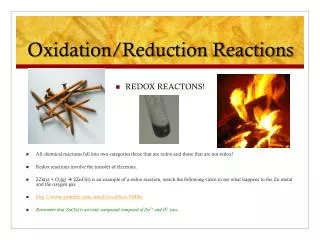
Rusting / corrosion Rust = Fe2O3.H2O (the red brown flaky stuff)
Steel making (cont) Fe2O3(S) + CO(g) → 2Fe (l) + 3CO2 (g) +3 +2 0 +4 oxidation reduction
Steel making (cont) Fe2O3 (s)+ 3CO (g) → 2Fe (s) + 3CO2 http://www.bbc.co.uk/history/interactive/animations/blast_furnace/index.shtml
Galvanic Cells Salt bridge = Electrolyte = Solution with ions to carry charge KCl (aq) or NO3(aq) ELECTROLYTES
Electroplating http://www.glenair.com/qwikconnect/vol7num4/electro.jpg
Spin-Coating – a simple way to produce thin films Films of ~100 nm can be routinely produced
Organic Light Emitting Diode (OLED) + Voltage source V volts – Field line + – Device material (Ru2+) Tris(2,2'-bipyridyl) Ruthenium(II) Electron (in the form of Ru+) and hole (Ru3+) migrate towards centre and recombine to produce light – A 3rd year Chem student practical at Adelaide University Positive charge or hole migration Electron migration 24
LESSON 2 OXIDATION AND REDUCTION
REDOX = OXidation + REDuction What is oxidation ? What is reduction?
What is oxidation? OXIDATIONISDEFINED AS : 1: LOSS OF HYDROGEN CH3 OH Cr2O72- → CH2O (methanol) H+ (heat) (methanal)
What is oxidation? OXIDATIONISDEFINED AS : 2: GAIN OF OXYGEN Mg(s) + O2(g) → 2MgO 2Ca (s) + O2(g) → 2CaO
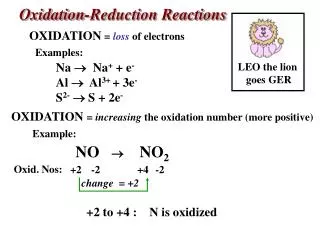
What is oxidation? 3:LOSS OF ELECTRONS =OXIDATION (LEO) OXIDATIONISDEFINED AS :
What is oxidation? 4: INCREASE IN OXIDATION NUMBER Fe (s) → Fe 2+ (aq) + 2e- 0 +2 OXIDATIONISDEFINED AS :
What is reduction? 1: GAIN OF HYDROGEN C3H6 (g) + H2(g) (catalyst) Ni → C3H8(g) (propene) heat pressure (propane) REDUCTIONISDEFINED AS :
What is reduction? REDUCTIONISDEFINED AS : 2: LOSS OF OXYGEN CuO (s) + H2(g) → Cu (s) + H2O (g)
What is reduction? REDUCTIONISDEFINED AS : O2(g) + 4e- → 2O2- (aq) 3:GAIN OF ELECTRONS =REDUCTION (GER)
What is reduction? REDUCTIONISDEFINED AS : 4: DECREASE IN OXIDATION NUMBER Cl2 (g) + 2e- → 2Cl-(aq) -1 0
When is it a redox reaction ? What about this reduction reaction? 2MnO4-(aq)+ 16H+ +10e- → Mn2+(aq)+ 8H2O(l) and this one? Cr2O72-(aq) +14H++6e- → 2Cr3+(aq)+ 7H2O(l)
Rules to determine oxidation numbers Rule1 ELEMENTS: ZERO H2 Li N2 O3 S8 Fe Cu Mg Cl2 O2 F2 uncombined with other elements their oxidation number is
Rules to determine oxidation numbers RULE 2 SIMPLE IONS: H+ =+1 Fe2+ = +2 = -2 O2- Al 3+ = +3 their oxidation number is the charge on the ion :
Rules to determine oxidation numbers RULE 3 OXYGEN: IN COMPOUNDS IS –2 [except in hydrogen peroxide (H2O2 )it is -1 compounds in which it is bounded to fluorine F2O it is +2 ] MgSO4 K2CO3 SO2 CO Na2O P4O10
Rules to determine oxidation numbers RULE 2 MOLECULES: THE SUM OF THE OXIDATION NUMBERS IS: ZERO What is the oxidation number of Phosphorus (P) inP4O10 4(Phosphorus ‘s oxidation number which we will take as x)+10( oxidation number of oxygen) = 0 4 X +10 (-2)= 0 4 X = 20 X=+5X=+IV YOU TRY : S in SO3… and Cl in HClO
Rules to determine oxidation numbers RULE 5 HYDROGEN: =+1 when in compound with a non metal H2O WATER NH4+ AMMONIUM NH3 AMMONIA HCl HYDROCHLORIC ACID
Rules to determine oxidation numbers RULE 6 COMPLEX / POLYATOMIC IONS: THE SUM OF ALL THE OXIDATION NUMBERS IS: CHARGE ON THE ION What is the oxidation number of S in SO42- ? SO42- (oxidation number of S is x) x+ 4 (-2) =-2 x -8 =-2 x= +8-2 x=+6
Using oxidation numbers to identify a redox reaction 0 Rule 1 +1 Rule 5 The oxidation number of hydrogen changes from 0 to +I Increase in oxidation number Hydrogen has been oxidised (undergoes oxidation) Hydrogen is the reductant (reducing agent) Is H2(g) + I2(g) → 2HI (g) a redox reaction?
Using oxidation numbers to identify a redox reaction Is H2(g) + I2(g) → 2HI (g) a redox reaction? 0 Rule 1 -1 Rule 4 and 5 The oxidation number of iodine changes from 0 to – I Decrease in oxidation number Iodine has been reduced (undergoes reduction) Iodine acts as the oxidant (oxidising agent)
Using oxidation numbers to identify a redox reaction Is H2(g) + I2(g) → 2HI (g) a redox reaction? -1 Rule 4+5 0 Rule 1 0 Rule 1 +1 Rule 5 Yes, oxidation number has changed for different chemical species
Using oxidation numbers to identify a redox reaction +1 Rule 5 0 Rule 1 +2 0 -2 +6 +6 -2 The oxidation number of magnesium changes from 0 to +2 Increase in oxidation number Magnesium metal has been oxidised (undergoes oxidation) Magnesium metal (Mg) is the reductant (reducing agent) The oxidation number of H (in H2SO4 changes from +1 to 0 (in H2) Decrease in oxidation number H2SO4 has been reduced (undergoes reduction) H2SO4 acts as the oxidant (oxidising agent) • Mg(s) + H2SO4 (aq) → MgSO4 (aq) + H2 (g)