SlideServe
Menu
Préférences
© SlideServe · v2026

Basic News Leads

harmon avatar
1 diapositives · 150 Views · Jul 15, 2014

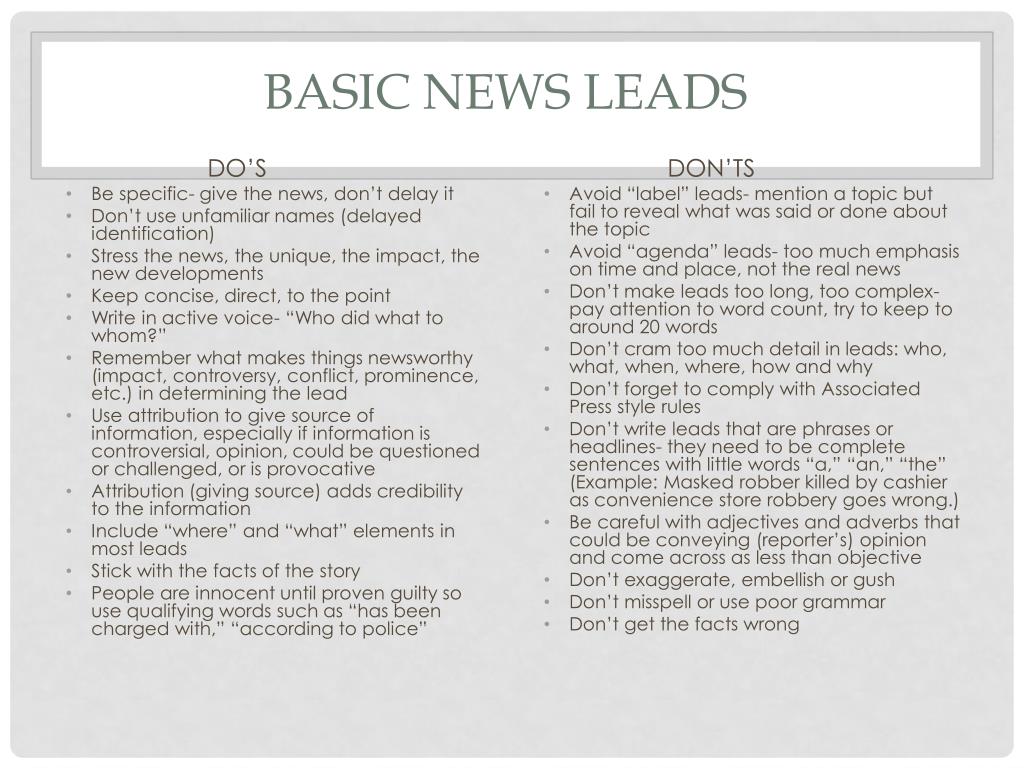
This concise guide provides journalists and writers with crucial do's and don'ts for crafting impactful news leads. It emphasizes the significance of specificity, clarity, and directness in news reporting. Key strategies include using active voice, providing source attribution, focusing on newsworthy elements like impact and conflict, and remembering journalistic integrity by avoiding bias. Writers are advised against using vague labels, long or complex sentences, and opinionated language. Following these principles will enhance the credibility and effectiveness of news stories.
Basic News Leads - slide 1
01 / 1Basic News Leads
1 / 17

Télécharger la présentation

Basic News Leads
Une image / un lien ci-dessous est fourni (tel quel) pour télécharger la présentation

Politique de téléchargement : le contenu du site vous est fourni TEL QUEL pour votre information et votre usage personnel ; il ne peut être vendu, concédé sous licence ni partagé sur d’autres sites sans l’accord de son auteur.Le contenu vous est fourni TEL QUEL, pour votre information et votre usage personnel uniquement. Téléchargez la présentation en cliquant sur ce lien. Lors du téléchargement, si vous ne parvenez pas à télécharger une présentation, l’éditeur a peut-être supprimé le fichier de son serveur.Pendant le téléchargement, si vous ne parvenez pas à obtenir une présentation, le fichier a peut-être été supprimé par l’éditeur.

F I N

Plus de contenu associé

Transcription de la présentation
  1. Basic News Leads DO’S • Be specific- give the news, don’t delay it • Don’t use unfamiliar names (delayed identification) • Stress the news, the unique, the impact, the new developments • Keep concise, direct, to the point • Write in active voice- “Who did what to whom?” • Remember what makes things newsworthy (impact, controversy, conflict, prominence, etc.) in determining the lead • Use attribution to give source of information, especially if information is controversial, opinion, could be questioned or challenged, or is provocative • Attribution (giving source) adds credibility to the information • Include “where” and “what” elements in most leads • Stick with the facts of the story • People are innocent until proven guilty so use qualifying words such as “has been charged with,” “according to police” DON’TS • Avoid “label” leads- mention a topic but fail to reveal what was said or done about the topic • Avoid “agenda” leads- too much emphasis on time and place, not the real news • Don’t make leads too long, too complex-pay attention to word count, try to keep to around 20 words • Don’t cram too much detail in leads: who, what, when, where, how and why • Don’t forget to comply with Associated Press style rules • Don’t write leads that are phrases or headlines- they need to be complete sentences with little words “a,” “an,” “the” (Example: Masked robber killed by cashier as convenience store robbery goes wrong.) • Be careful with adjectives and adverbs that could be conveying (reporter’s) opinion and come across as less than objective • Don’t exaggerate, embellish or gush • Don’t misspell or use poor grammar • Don’t get the facts wrong