
How Ecosystems Work
E N D
Presentation Transcript
How Ecosystems Work Honors Biology PFHS Chapter 5
Energy Flow in an open system • Life depends on the sun (energy source) • Energy captured by photosynthesis • This energy is used by organisms to move, grow, and reproduce • Energy is constantly coming in and going out of the earth system
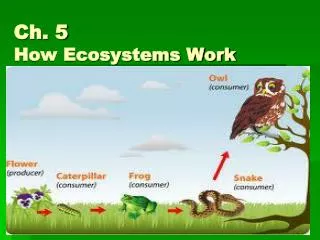
Niches Jobs, occupations, or roles in the ecosystem Examples: producer (autotroph), consumer (heterotroph), decomposer
Niches • Producer (autotroph) makes nutrient molecules from photo-/chemosynthesis
Niches • Consumer – obtains nutrient molecules by eating another organism • 1st order – herbivore; eats photosynthetic plants • 2nd order – carnivore; eats flesh of herbivore • Tertiary – carnivore/omnivore; eats flesh of carnivore/omnivore • Omnivore – eats both plant and animal material
Niches • Saprovore – eats dead/decaying material • Scavenger – roadkill specialist • Decomposer – breaks down dead material to energy and recycles matter to the environment
Burning the Fuel • Cellular respiration – 90% of energy obtained is used for daily activity; 10% available for next trophic level • C6H12O6 + 6O2 -----> 6CO2 + 6H20 + energy (heat and ATP)
Recycling of Matter in a Closed System • Closed system means a finite supply of matter; unlike infinite supply of energy • Material must be used over and over • Earth system has many biogeochemical cycles
Succession Defined: • The sequential change in the relative abundances of the dominant species in a biological community following a disturbance. • Primary succession: beginning from a abiotic environment following a cataclysmic disturbance. • Secondary succession: beginning from a major disturbance, but all forms of life are not destroyed.
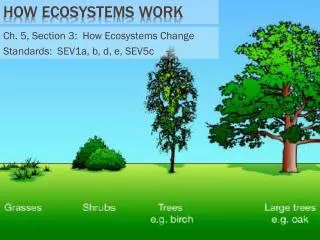
Primary Succession • No soil • Pioneer species take hold, break down rock and contribute organic material = soil • Grasses, shrubs, then trees after soils • Climax community • May vary • Depends on environment
Stages of Succession • Early: plants typically small with short lifecycles (annuals…), rapid seed dispersal, environmental stabilizers. • Middle: plants typically longer lived, slower seed dispersal, and in woodland systems: larger. • Late: plants and animal species are those associated with older, more mature ecosystem. • “Climax”?
Marine Succession 1 • Whale dies and sinks to floor • Scavengers/decomposers
Marine Succession 2 • Smaller # of organisms • Sediment dwellers with enrichment of sediments from decomposition
Marine Succession 3 • Skeleton remains • Heterotrophic bacteria decompose oils in bones • Release chemicals for chemosynthetic bacteria • Bacteria support mussels, limpets, snails, worms, crabs, clams, sediment dwellers around remaining bones
Fig 10.8 Graphs showing changes in biomass and diversity with succession.
“Greenhouse Effect” • Solar energy passes mostly unimpeded through the atmosphere and is absorbed at the surface • Outgoing long-wave radiation off the surface is absorbed by the atmosphere • A portion of the absorbed long-wave radiation is sent back down to the surface • The surface has a temperature 30˚ C warmer than it normally would have • This process is termed the “greenhouse effect”
“Greenhouse”?! • Greenhouses are certainly warm places on sunny days • However, greenhouses are not warm because of the trapping of infrared radiation • A greenhouse is warm because convection is inhibited by the glass (the warm air is stuck inside the greenhouse) • Therefore, the term “greenhouse effect” is a misnomer and does not apply to the atmosphere
Greenhouse Effect vs. Global Warming • The “greenhouse effect” is a good thing, otherwise we would be an ice planet • The terms “greenhouse effect” and “global warming” do not mean the same thing • Global warming is the concern that, by increasing the gases that trap infrared radiation in our atmosphere, we will increase the average surface temperature of the Earth