Apparent Weight
This article explores how gravity affects the apparent weight of objects, emphasizing the acceleration due to gravity at 9.8 m/s². We analyze the relationship between force, mass, and weight through Newton's laws. It details how vertical acceleration alters perceived weight, illustrated with examples, such as an accelerating elevator. We also discuss concepts like false weight and weightlessness in free fall scenarios. Key calculations are provided, highlighting the conditions under which weight appears to change, pivotal for understanding gravitational physics.

Apparent Weight
E N D
Presentation Transcript
Acceleration of Gravity • Objects that fall to the Earth all experience an acceleration. • The acceleration due to gravity is g = 9.8 m/s2. • This acceleration must be due to a force.
The acceleration of a falling mass m is -g. The force on the mass is found from F = ma (action). This gravitational force is F = -mg. Force of Gravity Kinematic view Dynamic view
Normal Weight • We measure weight with a scale that measures normal force. • W = mg • Weight is related to mass by the gravitational field g.
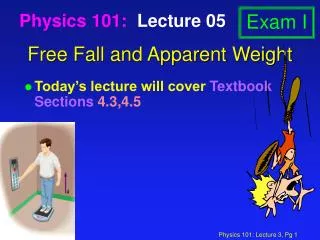
A vertical acceleration can change the weight. The normal force on the floor is our sense of weight. Downward acceleration reduces weight Upward acceleration increases weight Mass is unchanged. Newton’s law of acceleration F = ma net force, F = -mg + FN. Solve for the normal force -mg + FN = ma FN = ma + mg FN = m (a + g) Apparent mass based on g mapp = FN / g False Weight
Accelerated Weight • An elevator is accelerating downward at 2.0 m/s2. • The person has a mass of 70 kg. • What mass is on the scale? • Add all the forces, but the net force is –ma = FN – mg. • Solve for FN = m (g – a) • Convert to mass mapp = FN /g • The scale shows 56 kg.
Weightlessness • If the elevator accelerated downward at g, the normal force would become 0. • FN = m (g – a) = m (g – g) = 0 • The person would feel weightless. • An object in free fall is weightless, but not massless. Microgravity research at NASA next