PHOTOSYNTHESIS
Photosynthesis is a crucial process by which plants produce food using sunlight, carbon dioxide, and water. This process not only sustains plant life but is also the foundation of life on Earth, as all animals depend on the sugars produced by plants. The plant's parts—roots, stems, and leaves—work together cooperatively to ensure survival: roots absorb water, stems transport it, and leaves perform photosynthesis. Without cooperation among these parts, and without plants, life as we know it, including oxygen production and food supply, would be impossible.

PHOTOSYNTHESIS
E N D
Presentation Transcript
PHOTOSYNTHESIS PHOTOSYSTHESIS
Plants are part of a system in which cooperation is essential is order for the plant to survive. • Sunlight, Air, Temperature, and Water are all necessary variables for plant survival, and if one is absent the plant will not survive
Plant parts work together. The roots absorb water, the stems conduct it, so the leaves can use it to make food, which the stems conduct back to the roots for storage. • The law of cooperation can be seen in that if a particular part of the system does not fulfill its role the plant will not survive.
Photosynthesis • A process by which a plant produces its food using energy from sunlight, carbon dioxide from the air, and water from the soil.
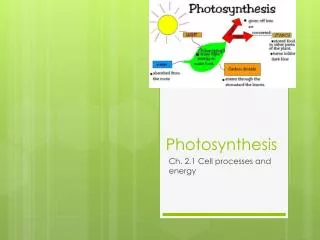
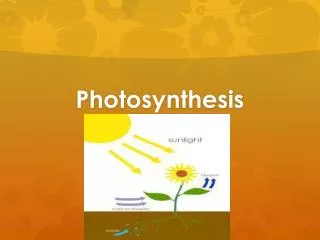
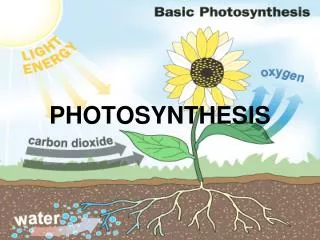
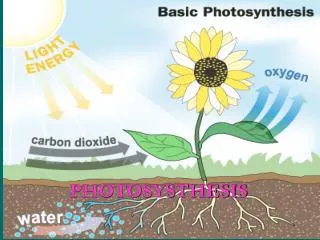
Photosynthesis is how plants use light and water to make sugar. Sugar is created in the green parts of a plant and every animal on earth depends on it. • Without plants we would have no food to eat or oxygen to breath. Here is a picture to show how it happens.
Plants absorb a common gas called carbon dioxide, pull water up through their roots and use light to make sugar. Plants use the sugar to grow. Plants give off oxygen as a by-product. The green parts of the plant makes the sugar and oxygen.
Carbon dioxide + water + sunlight = sugar + oxygen • D:\Nopphadol\workbook\Plant\ผลการค้นหารูปภาพโดย Google สำหรับhttp--www_mrsmacdonald_net-flwrparts_jpg.mht