Understanding Empirical and Molecular Formulas in Chemistry: A Guide
This guide explains the concepts of empirical and molecular formulas in chemistry, detailing how to determine the empirical formula from percent composition and convert it to molecular formulas using molar mass. By taking the example of fuel composition with 81.7% carbon and 18.3% hydrogen, we demonstrate the calculations for empirical formula determination. Additionally, readers will learn about the significance of hydrated ionic compounds, their formulas, and the role of mass spectrometry in molecular weight determination. This resource is essential for chemistry students.

Understanding Empirical and Molecular Formulas in Chemistry: A Guide
E N D
Presentation Transcript
Percent Composition Empirical Formula • The percent composition of fuel is 81.7% carbon and 18.3% hydrogen. What is the empirical formula of the fuel? • Start by assuming 100 g of the compound (81.7 g) / (12.01 g/mol) = 6.80 mol C (18.3 g) / (1.008 g/mol) = 18.2 mol H
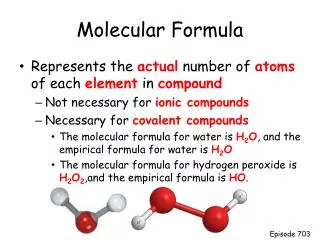
Molecular Formula • Recall that many compounds could potentially have the same empirical formula, but the molecular formula is specific to a given compound
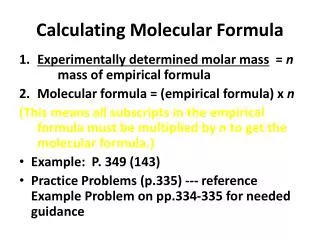
Molecular Formula • Molecular formula subscripts are a whole number multiple of the empirical formula subscripts • Similarly, the molar mass of a compound is a whole number multiple of the molar mass of the empirical formula • So, molar mass of the compound = n x molar mass of the empirical formula, where n = 1, 2, 3…
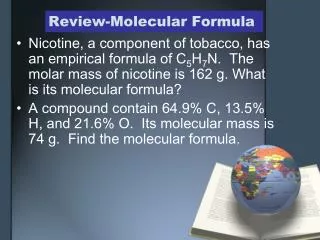
For Example: • A chemist determines that a substance has a empirical formula of CH and a molar mass of 78 g/mol. What is the molecular formula of the substance? • The empirical formula of CH is 13.0 g/mol • The ratio of the empirical formula to the molecular formula is = 6 • Therefore, we multiply the subscripts of the empirical formula by the ratio (6) to get the molecular formula: C6H6 78 13
Try This: • The empirical formula for ribose (a sugar) is CH2O. A mass spectrometer determined the molar mass of ribose to be 150 g/mol. What is the molecular formula of ribose?
Hydrated Ionic Compounds • Many ionic compounds crystallize from water solutions and end up with water incorporated into their structures, forming a hydrate (hydrated = contains water, anhydrous = without water) • For example, the chemical name for Epsom salts is magnesium sulfateheptahydrate (use prefixes to tell the number of water molecules in the compound) • MgSO4· 7H2O • The dot represents a weak bond • The molar mass of a hydrated compound must incorporate the mass of the water molecules in the compound
Example • A 50.0 g sample of a hydrate of barium hydroxide contains 27.2 g of Ba(OH)2. What is the percent, by mass, of water in the compound?
Example (cont.) • What is the formula for the hydrated barium oxide compound ? • 1. Moles of Ba(OH)2? • 2. Moles of H2O? • 3. Molar ratio?
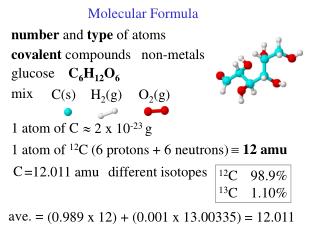
PS- what is amu? • The mass of an atom is expressed in atomic mass units (u or amu) • Relative measure • One atom of carbon 12 has a mass of 12 u (ie. One u has a mass of 1/12 that of a C-12 atom) • Average atomic mass (what we see on the periodic table) takes into account all isotopes (and their relative abundances) • One mole of an element has a mass (in grams) numerically equivalent to the element’s average atomic mass (in amu) • Take home: grams are numerically equivalent to amu.