Exploring Genomic Influences on Organism Development in Diverse Species
This research discusses the complexities of how genomes drive the development of various organisms, with a focus on sea urchin larvae, Heliconius butterflies, Geospiza finches, and Arabidopsis plants. It delves into the challenges in developmental biology, including cellular diversity, morphogenesis, and the factors affecting growth, repair, and regeneration. The integration of genetics and development is highlighted, emphasizing systematic analyses, gene regulatory networks, and the future of systems biology to enhance our understanding of organismal diversity and evolutionary processes.

Exploring Genomic Influences on Organism Development in Diverse Species
E N D
Presentation Transcript
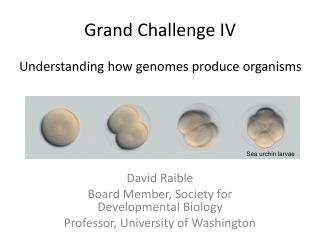
Grand Challenge IV Understanding how genomes produce organisms Sea urchin larvae David Raible Board Member, Society for Developmental Biology Professor, University of Washington
Grand Challenge IV Understanding how genomes produce organisms Generation of organismal diversity Heliconius
Grand Challenge IV Understanding how genomes produce organisms Generation of organismal diversity Geospiza
Grand Challenge IV Understanding how genomes produce organisms Environmental influences on growth Arabidopsis
The challenges in developmental biology • Generation of cellular diversity • Generation of shape: morphogenesis • Growth, repair, regeneration Drosophila
The challenges in developmental biology • Generation of cellular diversity • Generation of shape: morphogenesis • Growth, repair, regeneration Carollia
The challenges in developmental biology • Generation of cellular diversity • Generation of shape: morphogenesis • Growth, repair, regeneration Cnemidophorus
Progress at the interface • Convergence of genetics and development • Defining components • Integration of Cell Biology • Cell shape to tissue architecture • Systems biology – the future? • Moving beyond the descriptive
Systematic analysis of development • Gene regulatory networks
Systematic analysis of development • In toto imaging Kane and Karlstrom, 1995
Systematic analysis of development • In toto imaging • xyzgt http://www.embl.de/digitalembryo/
Moving forward • Instrumentation – ways to measure • Centralized databases (GCOB #11) • Access, analyze, manipulate large data sets • Standardization • New model organisms • Genomes • Genetics • Lab culture • Transgenics • Quantitative training
Moving forward • Distribution of effort • Centralized resources • Distribution of data • Recognition