Download
1 / 26
260 likes | 371 Vues
This guide explores key concepts in atmospheric science, including the layers of the atmosphere, weather phenomena, and climate patterns. It addresses questions such as the definitions and properties of the four atmospheric layers, air pressure variations, temperature conversions, cloud formation, and the development of storms like hurricanes and tornadoes. It also covers the impact of geography on climate, such as the effects of mountains and ocean currents. This comprehensive overview is essential for students and enthusiasts looking to deepen their understanding of weather and climate dynamics.

E N D
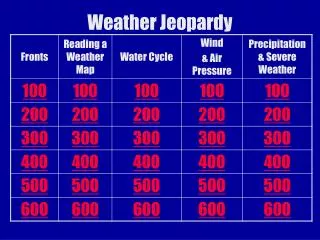
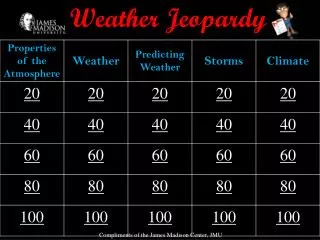
Weather Jeopardy Compliments of the James Madison Center, JMU
Properties of the Atm. - 20 What are the four (4) layers of the atmosphere listed from the lowest elevation to the highest elevation?
Properties of the Atm. - 40 List the three boundaries between the layers of the atmosphere from lowest elevation to the highest elevation.
Properties of the Atm. - 60 How do we define or identify the different layers of the atmosphere?
Properties of the Atm. - 80 What is the thickness of the Troposphere?
Properties of the Atm. - 100 Describe what happens to the temperature of each of the four layers of the atmosphere as elevation (altitude) increases.
Weather - 20 What is weather?
Weather - 40 Why is the air pressure the greatest in the Troposphere?
Weather - 60 • Convert the air pressure 996.0mb into Inches. • Convert the temperature 32oC to Fahrenheit.
Weather - 80 • What happens if the Dew Point temperature and the Air temperature are equal? • What will the Relative Humidity be if the Dew Point temperature and Air temperature are EQUAL?
Weather - 100 Explain how what happens to cause clouds to form.
Predicting Weather - 20 If we are looking at a map that show Isobars, how can we tell what direction the wind is flowing?
Predicting Weather - 40 Draw a Station Model that contains the following 5 things: • Air Temperature – 68oF • Barometric Pressure – 988.0mb • Wind Speed - 20 knots • Wind Direction – Southwest • Cloud Cover – 50%
Predicting Weather - 60 • Describe how the air flows in a Low Pressure System. • Describe how the air flows in a High Pressure System. You may use drawings to help explain.
Predicting Weather - 80 • Give the name and the conditions of the air in a mT air mass. • Give the name and the conditions of the air in a cPair mass.
Predicting Weather - 100 Describe what happens to the air at a Cold Front and draw the symbol that indicates one.
Storms - 20 What type of pressure system and location causes a hurricane to form?
Storms - 40 What type of temperature difference must occur for a tornado to occur?
Storms - 60 How does a thunderstorm form?
Storms - 80 What are the “Wet” Latitudes on the earth?
Storms - 100 What is occurring at an Occluded Front and draw the symbol for an Occluded Front?
Climate - 20 What happens to the climate of a region if it is farther away from the Equator?
Climate - 40 Describe what happens and what the climate will be like on the Leeward side of a mountain. Leeward
Climate - 60 Describe what happens and what the climate will be like on the Windward side of a mountain. Windward
Climate - 80 What is the name of the warm current that keeps England’s climate warm and wet all year round, even though it is so far North?
Climate – 100 Why is it that an area that lies near the water will have a warmer winter and a cooler summer when compared to an area that is not near the water?