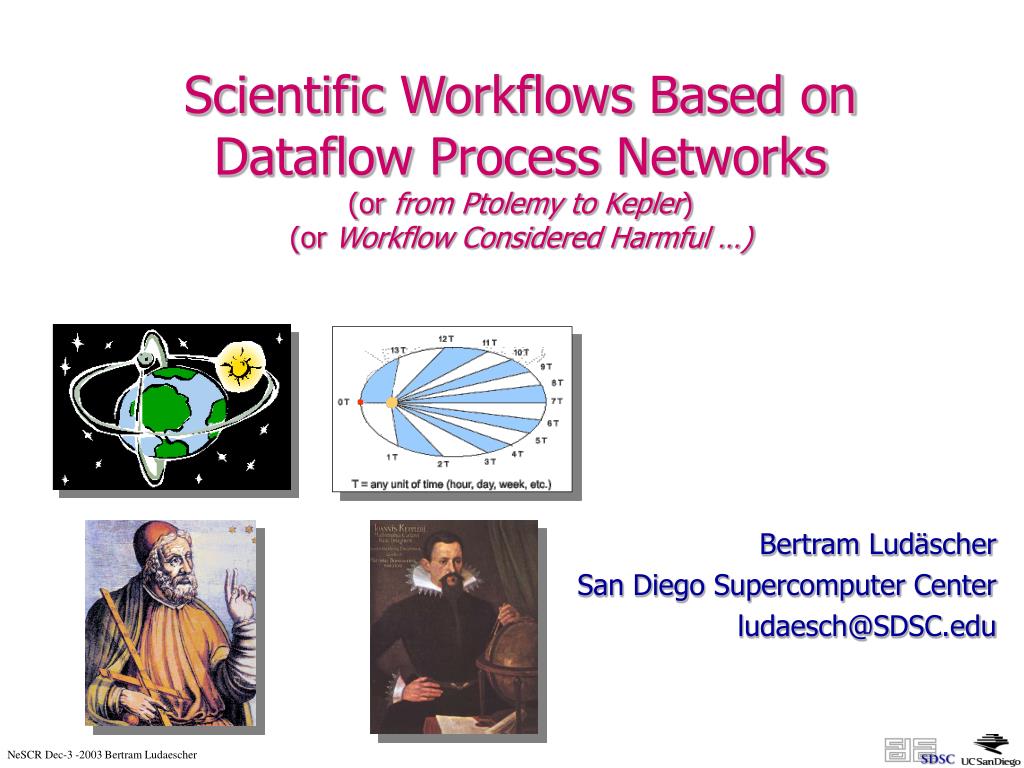
Scientific Workflows Based on Dataflow Process Networks (or from Ptolemy to Kepler ) (or Workflow Considered Harmful …). Bertram Lud ä scher San Diego Supercomputer Center ludaesch@SDSC.edu. Overview. Scientific Workflow (SWF) Examples SWF Requirements & Characteristics
01 / 64Bertram Lud ä scher San Diego Supercomputer Center ludaesch@SDSC
1 / 17
Télécharger la présentation
Bertram Lud ä scher San Diego Supercomputer Center ludaesch@SDSC
Une image / un lien ci-dessous est fourni (tel quel) pour télécharger la présentation
Politique de téléchargement : le contenu du site vous est fourni TEL QUEL pour votre information et votre usage personnel ; il ne peut être vendu, concédé sous licence ni partagé sur d’autres sites sans l’accord de son auteur.Le contenu vous est fourni TEL QUEL, pour votre information et votre usage personnel uniquement.Téléchargez la présentation en cliquant sur ce lien.Lors du téléchargement, si vous ne parvenez pas à télécharger une présentation, l’éditeur a peut-être supprimé le fichier de son serveur.Pendant le téléchargement, si vous ne parvenez pas à obtenir une présentation, le fichier a peut-être été supprimé par l’éditeur.
NSF, NIH, DOE GEOsciences Network (NSF) www.geongrid.org Biomedical Informatics Research Network (NIH) www.nbirn.net Science Environment for Ecological Knowledge (NSF) seek.ecoinformatics.org Scientific Data Management Center (DOE) sdm.lbl.gov/sdmcenter/ Acknowledgements I
Ilkay Altintas SDM Chad Berkley SEEK Shawn Bowers SEEK Jeffrey Grethe BIRN Christopher H. Brooks Ptolemy II Zhengang Cheng SDM Efrat Jaeger GEON Matt Jones SEEK Edward A. Lee Ptolemy II Kai Lin GEON Bertram Ludaescher BIRN, GEON, SDM, SEEK Stephen Neuendorffer Ptolemy II Mladen Vouk SDM Yang Zhao Ptolemy II … Coming soon!?: ROADNet, myGrid, GriPhyN, ... Acknowledgements II Ptolemy II
A Look Inside Classification Finer granularity Extracted from the mineral composition and this level’s diagram coordinates. Classifier: Locates the point’s region. Diagrams information and transitions between them. SVG to polygons. Displays the point in the diagram for this level.
SWF Requirements & Characteristics • Scientist friendly "problem solving environment" • WF design • WF execution • WF steering and UI • pause; revise; resume; rollback (cf. SCIRun) • repositories of reusable components • data and WF provenance (virtual data concept) • logging, cache reuse/partial re-derive, reports, … • Conceptual modeling support • complex data (semantics) support • “wiring” support (cf. web service composition) • planning support
SWF Requirements & Characteristics • "Modeling" support • Abstraction, hierarchical modeling • Models of Computation (MoC) • component interaction; combination of MoCs (cf. CCA) • WF multi-grain/granola: powder to bolders (and back) • Boolean (N)AND, (N)OR,… vs. chaining together Grid-apps • Rich data structures and type systems • End user "programming" support • high-level programming constructs • e.g. map/3 for iteration, filter, select, branch, merge, ... • data transformations • legacy tool integration (plug-ins) • data streaming • How to tame (e.g., starve a dataflow; then resume)? Zauberlehrling’sproblem
SWF Requirements & Characteristics • Grid-enabling SWFs • transparent use of (remote) resources • big data • big computation requirements • early/late binding of logical to physical resources, … • planning, scheduling, … cf. Chimera, Pegasus, DAGman, Condor(-G)
Scientific Workflows: Some Findings • More dataflow than (business) workflow • but some branching looping, merging, … • not: documents/objects undergoing modifications • instead often: dataset-out = analysis(dataset-in) • Need for “programming extension” • Iterations over lists (foreach); filtering; functional composition; generic & higher-order operations (zip, map(f), …) • Need for abstraction and nested workflows • Need for data transformations (compute/transform alternations) • Need for rich user interaction & workflow steering: • pause / revise / resume • select & branch; e.g., web browser capability at specific steps as part of a coordinated SWF • Need for high-throughput transfers (“grid-enabling”, “streaming”) • Need for persistence of intermediate products data provenance (“virtual data” concept)
Business Workflows • Business Workflows • show their office automation ancestry • documents and “work-tasks” are passed • no data streaming, no data-intensive pipelines • lots of standards to choose from: WfMC, WSFL, BMPL, BPEL4WS,.. XPDL,… • but often no clear execution semantics for constructs as simple as this: Source: Expressiveness and Suitability of Languages for Control Flow Modelling in Workflows, PhD thesis, Bartosz Kiepuszewski, 2002
On Workflow Standards… http://tmitwww.tm.tue.nl/staff/wvdaalst/Publications/publications.html
Workflow “Standards” Debunked Source: Don’t go with the flow:Web services composition standards exposed,W.M.P. van der Aalst, Trends & Controversies, Jan/Feb 2003 issue of IEEE Intelligent Systems Web Services - Been there done that?
Workflow “Standards” Debunked Source: Don’t go with the flow:Web services composition standards exposed,W.M.P. van der Aalst, Trends & Controversies, Jan/Feb 2003 issue of IEEE Intelligent Systems Web Services - Been there done that?
SCIRun: Component-Based Problem Solving Environments for Large-Scale Scientific Computing • SCIRun: problem solving environment for interactive construction, debugging, and steering of large-scale scientific computations • Component model, based on generalized dataflow programming • Contact: Steve Parker (cs.utah.edu); SciDAC/SDM collaboration
typed i/o ports FIFO actor actor Dataflow Process Networks:Putting Computation Models first! • Synchronous Dataflow Network (SDF) • Statically schedulable single-threaded dataflow • Can execute multi-threaded, but the firing-sequence is known in advance • Maximally well-behaved, but also limited expressiveness • Process Network (PN) • Multi-threaded dynamically scheduled dataflow • More expressive than SDF (dynamic token rate prevents static scheduling) • Natural streaming model • Other Execution Models (“Domains”) • Implemented through different “Directors” advanced push/pull
see! Dataflow Process Networks and Ptolemy-II read! try! Source: Edward Lee et al. http://ptolemy.eecs.berkeley.edu/ptolemyII/
Why Ptolemy-II? • PTII Objective: • “The focus is on assembly of concurrent components. The key underlying principle in the project is the use of well-definedmodels of computation that govern the interaction between components. A major problem area being addressed is the use of heterogeneous mixtures of models of computation.” • Data & Process oriented: • Dataflow process networks • Natural Data Streaming Support • End user “WF console” (Vergil GUI) • PRAGMATICS • mature, actively maintained, well-documented • open source system • leverage “sister projects” activities (e.g. SEEK, SDM, BIRN,…)
Scientific Workflows = Dataflow Process Networks + X • X = … • Database plug-ins • Legacy application plug-ins (via command line, as web services, …) • Grid extensions: • Actors as web/grid services • 3rd party data transfer, high-throughput data streaming • Dealing with thousands of files (cf. astrophysics, astronomy, HEP, … examples) • Data and servicerepositories, discovery Extended type system (structural & semantic extensions) • Programmingextensions (declarative/FP) and • Rich user interactions/workflow steering • Rich data transformations (compute/transform alternations) • Data provenance • (semi-)automatic meta-data creation Kepler = Ptolemy-II + X
Status update / specific tasks for Kepler$DONE, %ONGOING, *NEW • User interaction, workflow steering • $ Pause/revise/resume • $ BrowserUI actor (browser as a 0-learning display and selection tool) • Distributed execution • $ Dynamically port-specializing WSDL actor • * Dynamically specializing Grid service actor • Port & actor type extensions (SEEK leverage) • * Structural types (XML Schema) • * Semantic types (OWL) incl. unit types w/ automatic conversion • Programming extensions • % Data transformation actors (XSLT, XQuery, Python, Perl,…) • * map, zip, zipWith, …, loop, switch “patterns” • Specialized Data Sources • $ EML (SEEK), • % MS Access (GEON), *JDBC, • *XML, *NetCDF, …
Some specific tasks for Kepler (all NEW) • Design & develop transparent, Grid-enabled PNs: • Communication protocol details • Grid-actor extensions and/or • Grid-Process Network director (G-PN) • Host/Source-location becomes actor parameter • add “active-inline” parameter display for grid-actors (@exec-loc), channels (@transport-protocol), source-actors (@{src-loc|catalog-loc}) • Activity Monitoring • Add “activity status” display (green, yellow, red) to replace PtII animation (needed for concurrently executing PN!) • Registration & Deployment mechanisms • Actor/Data/Workflow repository (=composite actors) • Shows up as (config’able) actor library • OGSA Service Registry approach? (SEEK leverage; UDDI complex & limited says MattJ) • http://www-unix.globus.org/toolkit/draft-ggf-ogsi-gridservice-33_2003-06-27.pdf • Extensions to deal with failures (fault tolerance)
Example: Grid-enabling Ptolemy II ( Kepler-SEEK, Chad Berkley Kepler-SDM, Ilkay Altintas, … myGrid?, … …GriPhyN?, … … OGS{I|A}-[DAI] ...)
Transparently Grid-Enabling PTII: Handles Logical token transfer (3) requires get_handle(1,2); then exec_handle(4,5,6,7) for completion. • AGA: get_handle • GAA: return &X • AB: send &X • BGB: request &X • GBGA: request &X • GA GB: send *X • GBB: send done(&X) • Example: • &X = “GA.17” • *X =<some_huge_file> PTII space 3 A B 4 7 2 1 5 Grid space GA GB 6
Transparently Grid-Enabling PTII • Different phases • Register designed WF (could include external validation service) • Find suitable grid service hosts for actors • Pre-stage execution • Execute (w/ provenance) • Interactively steer (pause; revise; resume) • Batch process; re-run parts later • Register/store data products and execution logs • Kepler implementation choices: • Grid-actors (no change of Director necessary!?) and/or • Grid-(PN)-director (also need to change actors!?) • Add grid service host id as actor parameter: A@GA • Similar for data: myDB@GA
“C-z ; bf &” – Detach your WF execution! • Currently in PTII • tight coupling of WF execution and PTII Java client (also Vergil GUI) • To-do for Kepler: • detaching WF console (Vergil) from a Grid-aware execution engine Grid-PN Director! Transport protocol parameter Data location parameter Host location parameter
Semantic Type Extensions • Take concepts and relationships from an ontology to “semantically type” the data-in/out ports • Application: e.g., design support: • smart/semi-automatic wiring, generation of “massaging actors” m1 (normalize) p3 p4 Takes Abundance Count Measurements for Life Stages Returns Mortality Rate Derived Measurements for Life Stages
Connexion au compte
Connectez-vous pour publier votre contenu sur SlideServe.