Download
1 / 11
110 likes | 229 Vues
Chemical bonds are vital connections that form when atoms combine, aiming for stability by achieving a full outer shell of electrons, similar to noble gases. This interaction results in the formation of compounds, which can be solids, liquids, or gases. There are three main types of chemical bonds: ionic, covalent, and metallic. Ionic bonds involve electron transfer, while covalent bonds entail electron sharing. Electronegativity influences bond formation and properties. This guide explores the nature and significance of chemical bonds, with examples like water (H2O) and sodium chloride (NaCl).

E N D
Chemical Bonds • All atoms seek a state of balance - a full outer shell of electrons • Number of electrons in the outer orbit (shell) gives the element its chemical & physical properties • All atoms want to have an electron structure of a noble (inert) gas
Chemical Bonds • Therefore: a chemical bond is produced • Atoms bond together to form a compound • Compound - a combination of elements • Compounds can be a solid, liquid, or a gas
Chemical Bonds • Molecule • Result of a chemical bond • Smallest particle with its unique identity • Water - H2O • Air – O2 • N - 78% • O - 21% • Ar - 1%
Chemical Bonds • Valence electrons • Electrons located in the outer orbit (shell) • Participate in chemical bonding • Inner orbits are stable • Chemical Bonds • A process of transfer, (giving/receiving) or sharing of electrons in order to reach a stable state • 3 types • Ionic bonds • Covalent bonds • Metallic bonds
Chemical Bonds • Ionic bond • Electrons are transferred (received or given-up) • + or - ion is formed • Metal from the left side of the PT reacts with a nonmetal from the right side of the PT Sodium • Chloride - NaCl - table salt • Sodium - left - 1 electron to give • Chlorine - right - needs 1 electron
Chemical Bonds • Covalent Bonds • Electrons are shared • Nothing given or received • Form between the nonmetallic elements (right)
Chemical Bonds • Examples of Covalent bonds • HCl • Hydrogen Chloride • CH4 • Methane • H2O • Water • SiO2 • Quartz • CCl4 • Carbon tetrachloride • CO • Carbon monoxide • C6H12O6 • Glucose
Chemical Bonds • Metallic bonds • Electrons are shared
Chemical Bonds • Ionic Bond vs Covalent Bond • Ionic bonds • Electrons are transferred • Form between metals & nonmetals • Metals – left side of PT • Nonmetals – right side of PT • Covalent bond • Electrons are shared • Forms between nonmetals
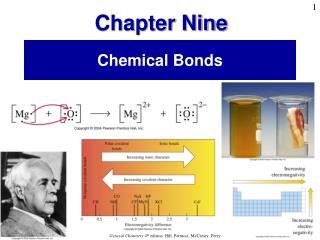
Chemical Bonds • Electronegativity • An atom’s pulling ability • Difference in the electronegativity will determine the bond type • Fig. 9.10 (p. 259)
Chemical Bonds • Compound Names • ide suffix - compound contains 2 elements