Photosynthesis
170 likes | 259 Vues
Explore the fascinating world of photosynthesis, where sunlight transforms water and carbon dioxide into sugars and oxygen. Discover the key players like chlorophyll and chloroplasts, as well as the intricate processes involved in light-dependent reactions. Uncover the factors influencing photosynthesis and the importance of this biological phenomenon in sustaining life on Earth.


Photosynthesis
E N D
Presentation Transcript
Photosynthesis Chapter 8
Trophs • Autotrophs • Heterotrophs
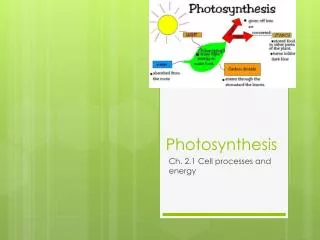
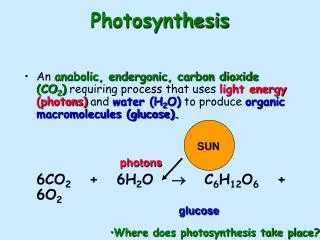
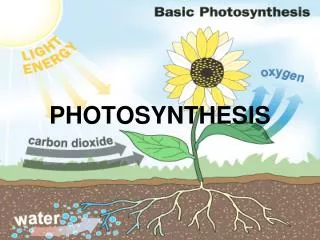
Photosynthesis 6CO2 + 6H2O C6H12O6 + 6O2 • Photosynthesis uses the energy of sunlight to convert water and carbon dioxide into high-energy sugars and oxygen. • Green things are generally understood to be photosynthesizers
Chlorophyll • Chlorophyll a • Chlorophyll b • Pigments that absorb varying frequencies of light. • Poor absorbers of blue-green frequency
Chloroplasts • Thylakoids- contain photosystems which are the light-collecting units • Sunlight excites electrons in the chlorophyll which are then passed to electron carriers (Sound familiar?) • NADP+ is charged with an electron to form NADPH
Light Dependence • Two reactions are considered light-dependent in photosynthesis • Photosystem II absorbs light and produces energized electrons, H+ ions, and water. • Photosystem I receives tired electrons from II, are re-energized by sunlight, and used to make NADPH which passes to Calvin.
Mr. Calvin • ATP and NADPH from the light-dependent reactions are used by the Calvin Cycle to create sugars.
Factors Affecting Photosynthesis • Water availability • Sunlight intensity • Temperature (photosynthetic enzymes function best from 0-35 degrees C) • Light Wavelength
light Back and Forth 6CO2 + 6H2O C6H12O6 + 6O2
O2 + sugar CO2 +H2O