Blocking Strategies for Strength-2 Orthogonal Arrays: Optimality and Applications
This study explores the design problem of blocking strategies for orthogonal arrays of strength-2, focusing on five key factors. We analyze optimality criteria and provide methods for searching through an ordered design catalog. The research discusses the implications of blocking in various scenarios, such as inter-block information recovery and error estimation improvements. Additionally, it offers insights into existing methodologies and their limitations, culminating in conclusions about the classification of designs and potential applications in two-level arrays.

Blocking Strategies for Strength-2 Orthogonal Arrays: Optimality and Applications
E N D
Presentation Transcript
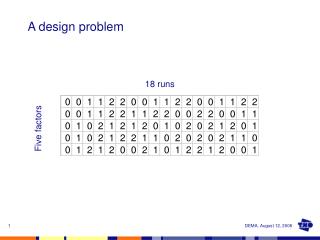
A design problem 18 runs Five factors
A design problem Block 3 Block 1 Block 2
A blocking strategy for Orthogonal Arrays of strength 2 Eric Schoen, TNO Science & Industry (Delft, Holland) / U. of Antwerp (Belgium)
Contents • Optimality criteria for strength-2 designs and blocking • Searching an ordered design catalog • Conclusions
n factors (A1, A2, …, An) Ap: sum of squared and standardized inner products of q and (p-q)-factor interactions Generalizes WLP for regular designs. Generalizes G2-aberration for two-level designs Xu and Wu (2001), Annals Generalized Word Length Pattern
Including the blocking factor: OA(18; 36; 2) Excluding the blocking factor: OA(18; 35; 2) subtraction (A3, A4) = (13, 13.5) (A3, A4) = ( 5, 7.5) ________________ (A21, A31)= (8, 6) Confounding 2fi/3fi with blocks Application to introductory design
Three blocking criteria If we can recover inter-block information: W1: ttt << tttt << ttb << tttb If there is no hope to recover inter-block information: W2: ttt << ttb << tttt << tttb To improve error estimation: W3: ttt << -ttb << tttt << tttb
Schoen (2007): all combinatorially non-isomorphic 18-run arrays Ordered according to GWLP 2, 3 or 6 blocks Searching an ordered design catalog
Minimization of ttt words (all criteria): 5.0.1 is the unique array with minimum ttt W1 (ttt << tttt) is satisfied if 36 designs project into minimum aberration 35 6.0.1, 6.0.5, 6.0.8 project into 5.0.1 Minimization of ttb (W2): Choosing 6.0.1 minimizes A3(6 factors) – A3 (5 factors) Maximization of ttb (W3): Choosing 6.0.8 maximizes A3(6 factors) – A3 (5 factors) Simple selection
Application to two-level arrays • Existing method: combine two-level columns to a four-level column. • Does not work for N=20. • However, we can generate OA(20; 5 x 2a). • This permits blocking in five blocks of size 4.
Conclusions • Blocking of orthogonal arrays. • Classification with GWLP. • GWLP catalog including blocking factor. • Projections into arrays with one factor less. • Three blocking criteria, including maximization of ttb words.