Evolution of Data Documentation
This document explores the evolution of data documentation, focusing on the limitations and challenges of early digital codebooks. It discusses the need for more flexible and reusable frameworks in documenting studies, files, and variables, emphasizing the transition from DDI 1 and 2 to DDI 3. Key features of DDI 3 include enhanced categorization of study concepts, data collection, processing, distribution, archiving, discovery, analysis, and repurposing. The analysis highlights how modern documentation should evolve to support dynamic research environments.

Evolution of Data Documentation
E N D
Presentation Transcript
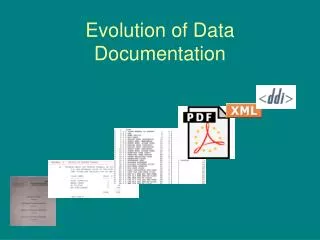
Evolution of Data Documentation ICPSR 2012
Codebooks! • Description of study • Description of files • Description of variables • Survey instrument • Classification Standard
Codebooks! • Location of variables in the data file
Codebooks! • Values, Labels, Frequencies…
Problems of early digital codebooks (part 1) PDF Osiris Osiris dictionary SPSS cards SPSS CBLT Book
(user has to re-create information inorder to re-use information) PDF Machine “readable” but not Machine “actionable” Osiris Osiris dictionary SPSS cards SPSS CBLT Book
DDI 1 and 2 Built to emulate early code BOOKS and digital Codebooks… 1.0 DOCUMENT DESCRIPTION 2.0 STUDY DESCRIPTION 3.0 DATA FILES DESCRIPTION 4.0 VARIABLE DESCRIPTION 5.0 OTHER STUDY-RELATED MATERIALS
Problems of early digital codebooks (part 2) • Static, inflexible. • Meant to document the end point of research -- Views research as linear. • Hard to re-use the information for new research.
Problems of DDI 1 and 2 • Emulated the Code Book • Not flexible enough • We could do so much more…
DDI 1 and 2 • Document Description • Study Description • Data Files Description • Variable Description • Other Study-Related Materials
DDI 1 and 2 DDI 3 • Document Description • Study Description • Data Files Description • Variable Description • Other Study-Related Materials • Study Concept • Data Collection • Data Processing • Data Distribution • Data Archiving • Data Discovery • Data Analysis • Repurposing