
Data Representation
E N D
Presentation Transcript
Joe Hacker 123 Main Plainfield Il 60544 Fields Records Files
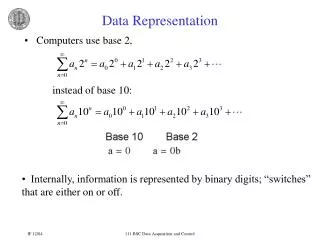
Decimal • MSD LSD • dx d4 d3 d2 d1 d0 Digit Position • 10x 104 103 102 101 100 Placement Value • 10,000 1,000 100 10 1 Positional Value • 0 0 0 0 0 0 Symbols • 1 1 1 1 1 • 2 2 2 2 2 • 3 3 3 3 3 • 4 4 4 4 4 • 5 5 5 5 5 • 6 6 6 6 6 • 7 7 7 7 7 • 8 8 8 8 8 • 9 9 9 9 9
7903 (7 X 10³) + (9 X 10²) + (0 X 101) + (3 X 100) = (7 X 1000) + (9 X 100) + (0 X 10) + (3 X 1) = 7000 + 900 + 0 + 3 = 7903
Binary MSD LSD dx d4 d3 d2 d1 d0Digit Position 2x 24 23 22 21 20 Placement Value 2x2x2x2 2x2x2 2x2 2x2 2x0 16 8 4 2 1 Positional Value 0 0 0 0 0 0 Symbols 1 1 1 1 1 1
Binary to Decimal Conversion Binary Number: 1011 Exponent: 3210 Decimal = 1*20 + 1* 21 + 0*22 + 1*23 = 1 + 2 + 0 + 8 = 11
Binary Representation 128 64 32 16 8 4 2 1 1 Byte = 8 Bits (Binary digits)
Hexadecimal • Use Hex 0-9 for decimal 0-9 • Use Hex A-F for decimal 10-15 Each Hex can be translated into 4 binary digits. Each 4 binary digits can be translated into a Hex digit. Note: a byte = 4 bits Each byte can be written as a Hex
Hex Representation 65536 4096 256 16 1
Example Binary 1101 1110 0001 Decimal 13 14 1 Hex D E 1
Example • Hex to Dec Hex 2 C Exponent 1 0 Dec = 2(16)1 + C (16)0 = 32 + 12(1) = 32 + 12 = 44
Address Register Bits Addressable Memory (bytes) Memory size 891011121314151617181920212223242526272829303132 2565121,0242,0484,0968,19216,38432,76865,536131,072262,144524,2881,048,5762,097,1524,194,3048,388,60816,777,21633,554,43267,108,864134,217,728268,435,456536,870,9121,073,741,8242,147,483,6484,294,967,296 1K2K4K8K16K32K64K128K256K512K1M2M4M8M16M32M64M128M256M512M1G2G4G Addressable memory by address register size
Measurements of Memory 1 K = 1,024 bytes = 210 1 MegaByte (M) = 1,048,576 bytes = 220 1 GigaByte (G) = 1,073,741,824 bytes = 230 16.7 M = 16,777,215 bytes = 224
$64 Million Question $$$$$$$$$$$$$$$$$$$$$$$ What does this have to do with security? $$$$$$$$$$$$$$$$$$$$$$$