Download

1 / 7
70 likes | 201 Vues
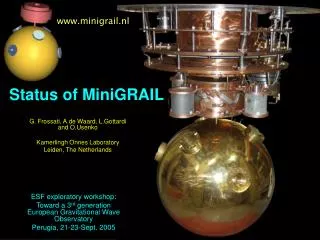
The MiniGRAIL project, a collaboration between the Kamerlingh Onnes Laboratory at Leiden University and the ROG and AURIGA groups, is preparing for the next cool-down following lessons learned from the 2005 cool-down. Challenges faced include low transducer sensitivity at 60 mK, instability of SQUIDs due to RF noise, and insufficient cooling power from the dilution refrigerator. Proposed improvements involve new transducers with larger surface areas and reduced mass, enhanced shielding, and advanced SQUID technology aimed at significantly improving spectral strain sensitivity toward quantum limits.

E N D
MiniGRAIL “Extreme Make-over” Giorgio Frossati Kamerlingh Onnes Laboratory Leiden University In collaboration with ROG group AURIGA-group
The spherical gravitational wave antenna MiniGRAIL is being prepared for the next cool-down, using the experience acquired with the last cool-down of 2005. The problems found were: 1- Lack of sensitivity of the transducers when cooled to 60mK. The thermally excited resonance were barely above the thermal noise. The best spectral strain sensitivity was ~8x10-21 /√Hz , still more than two orders of magnitude lower than the quantum limit of 4x10-23/√Hz 2- Instability of the SQUIDs due to RF noise and too high an intrinsic SQUID noise 3- Relatively low cooling power of the dilution refrigerator limiting the minimum sphere temperature to 60 mK.
Improve sensitivity • new transducers: • Larger surface area • Smaller mass 6 new transducers
Decrease the external EM perturbations: -Super-conducting shielding -Magnetic (Glasmet) shielding -Low frequency vibrations damping 6 new transducers
Improve transducer read out: super-conducting and magnetic shielding 6 new transformers 6 new transducers
Improve SQUID sensitivity: super-conducting and Mu-metal shielding 2-stage Twente 6 new transformers New double SQUIDs 2-stage Trento 6 new transducers
new dilution refrigerator unit: Super-conducting and mu-metal shielding 6 new transformers new dilution refrigerator • large surface mixing chamber and heat exchangers • expected cooling power of at least 50 microW at 30 mK 6 new transducers