SlideServe
Menu
Préférences
© SlideServe · v2026

Agenda Warm Up Review HW Turn in HW Packets E#3 to E#7 Power Notes Power Practice

hedy avatar
10 diapositives · 559 Views · Jul 30, 2014

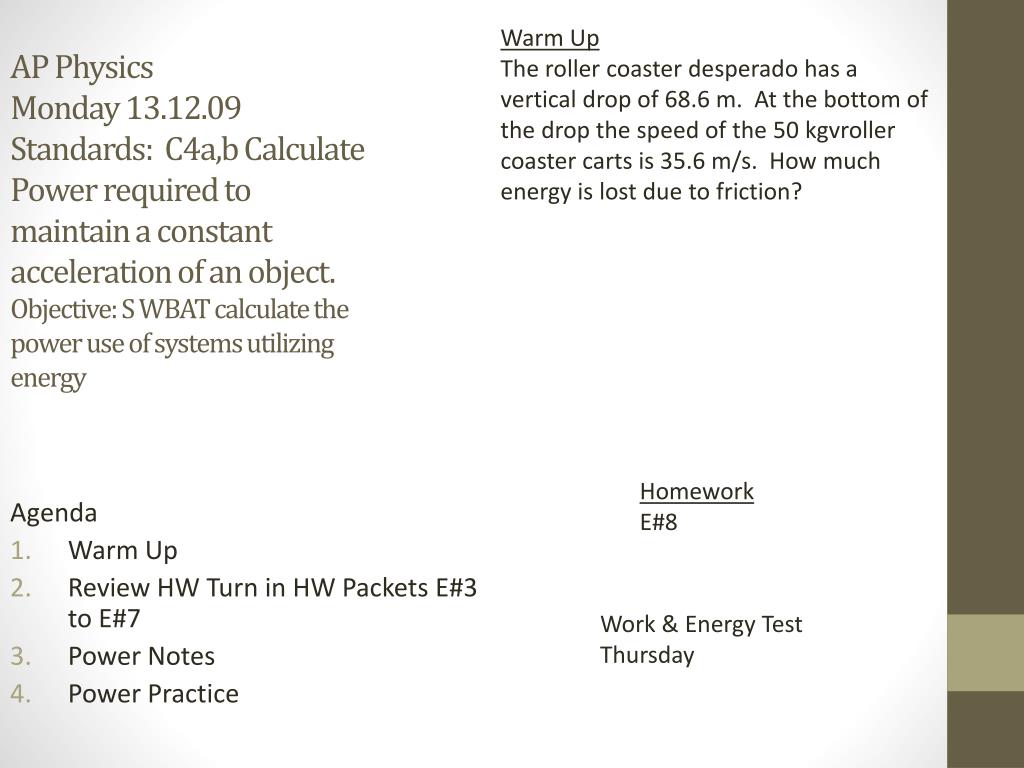
Warm Up The roller coaster desperado has a vertical drop of 68.6 m. At the bottom of the drop the speed of the 50 kgvroller coaster carts is 35.6 m/s. How much energy is lost due to friction? .
Agenda Warm Up Review HW Turn in HW Packets E#3 to E#7 Power Notes Power Practice - slide 1
01 / 10Agenda Warm Up Review HW Turn in HW Packets E#3 to E#7 Power Notes Power Practice
1 / 17

Télécharger la présentation

Agenda Warm Up Review HW Turn in HW Packets E#3 to E#7 Power Notes Power Practice
Une image / un lien ci-dessous est fourni (tel quel) pour télécharger la présentation

Politique de téléchargement : le contenu du site vous est fourni TEL QUEL pour votre information et votre usage personnel ; il ne peut être vendu, concédé sous licence ni partagé sur d’autres sites sans l’accord de son auteur.Le contenu vous est fourni TEL QUEL, pour votre information et votre usage personnel uniquement. Téléchargez la présentation en cliquant sur ce lien. Lors du téléchargement, si vous ne parvenez pas à télécharger une présentation, l’éditeur a peut-être supprimé le fichier de son serveur.Pendant le téléchargement, si vous ne parvenez pas à obtenir une présentation, le fichier a peut-être été supprimé par l’éditeur.

F I N

Plus de contenu associé

Transcription de la présentation
  1. Warm Up The roller coaster desperado has a vertical drop of 68.6 m. At the bottom of the drop the speed of the 50 kgvroller coaster carts is 35.6 m/s. How much energy is lost due to friction? AP PhysicsMonday 13.12.09 Standards: C4a,b Calculate Power required to maintain a constant acceleration of an object.Objective: S WBAT calculate the power use of systems utilizing energy Agenda • Warm Up • Review HW Turn in HW Packets E#3 to E#7 • Power Notes • Power Practice Homework E#8 Work & Energy Test Thursday

  2. Warm Up Freebie: What kind of graph did you create for Friday’s lab? AP PhysicsTuesday 13.12.10Standards: C1b2&3 Objective: SWBAT extend their understand of energy by applying those principles to more complex situations. Agenda • Warm Up • Review HW • Extension Assignment E#9 Homework E#9 Review Lab Due Tomorrow

  3. Warm Up A compressed spring has 16 J of of potential energy. What is the maximum speed it can impart to a 2 kg object? AP PhysicsWednesday 13.12.11Standards: C2b4&5 conservative forces & potential energy from gravity and springs Objective: SWBAT review for their test. Agenda • Warm Up • Collect Energy Lab • Test Review Homework Study For Test

  4. Warm Up Study for test 5 min. Write down one thing you learned while preparing. AP PhysicsThursday 13.12.05Standards: C3ab: Conservation of EnergyObjective: SWBAT score 4 or higher on their energy exam. Agenda • Warm Up • Take Energy Exam Homework Finalize Lab

  5. Warm Up Find the change in kinetic energy if a 5kg object is held 10 m in the air then dropped onto a table 2 meters in the air. AP PhysicsFriday 13.12.06Standards: Cab Conservation of Energy1b3 Objective: SWBAT learn from their mistakes on the exam. Agenda • Warm Up • Review Test • Correct Mistakes Homework Final Review will be online by Saturday. Finish Correcting Test Mistakes.

  6. AP Lab Write Up Rubric

  7. Conservation of Energy Lab Objective: Students will use the concept of conservation of energy to verify the mass of the marble by rolling it down ramps of different heights. Theory: Conservation of Energy: As Potential Energy decreases, kinetic energy increases, so by the time the ball reaches the flat surface all the potential energy should have been converted into kinetic energy. How will you know you’re successful? -The slope of your ___ vs ____ graph will equal (½)m. Using that slope you will be able to calculate mass. -You can compare your experimental mass value with the found found using a spring scale and/or a triple beam balance using a percent error calculation. Lab Write Up, Using Standard Lab Write Up Rubric Due Wednesday

  8. Power #E8 • (1) The most powerful ice breaker in the world was built in the former Soviet Union. The ship is almost 150 m long, and its nuclear engine generates 56MW of power. How much work can this engine do in 1.0 h? • (2) Reginald Esuke from Cameroon ran over 3 km down a mountain slope in just 62.25 min. How much work was done if the power developed during Esuke’s descent was 585.0W. • (4) The first practical car to use a gasoline engine was built in London in 1826. the power generated by the engine was just 2984 W. How long would this engine have to run to produce 3.60x10⁴J of work? • (5) Dennis Joyce of the United States threw a boomerang and caught it at the same location 3.0 min later. Suppose Joyce decided to work out while waiting for the boomerang to return. If he expended 54 kJ of work, what was his average power output during the workout? • (6) In 1984, Don Cain threw a flying disk that stayed aloft for 16.7 s. Suppose Cain ran up a staircase during this time, reaching a height of 18.4 m. If his mass was 72.0 kg, how much power was needed for Cain’s ascent?

  9. Power Most things require a continuous flow of energy in order to run. They require power. Average Power = Work/time or Force*average velocity P=W/t = Fv The Units of Power are Watts or J/s. We see Power mostly in reference to light bulbs and things that we plug in. The electricity companies measure our electricity consumption using kW*hr to bill us.

  10. Power Guided Practice Martinus Kuiper of the Netherlands ice skated for 24 h with an average speed of 6.3 m/s. Suppose Kuiper’s mass was 65 kg. If Kuiper provided 520 W of power to accelerate for 2.5 s, how much work did he do?