The Science of Fingerprint Identification: Methods and Systems Explained
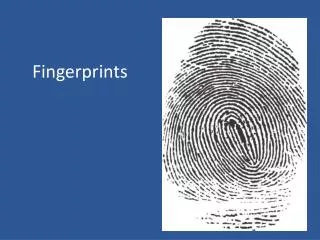
Fingerprints are unique and have become critical tools for identification in criminal investigations. Each fingerprint exhibits distinct patterns categorized into loops, whorls, and arches. The development of classification systems and automated databases like AFIS and IAFIS has revolutionized fingerprint analysis. Various types of fingerprints—plastic, visible, and latent—offer different challenges. Techniques for searching, enhancing, and identifying these prints include chemical reactions, dusting, and microscopic comparison. This overview explores their historical significance and modern methodologies in forensic science.

The Science of Fingerprint Identification: Methods and Systems Explained
E N D
Presentation Transcript
Reasons they became useful • Discovered that they are unique. No 2 alike. • A classification system was developed. • Loops • Whorls • Arches
Classification • Computer database • AFIS Automated Fingerprint Identification System • 1990 • IAFIS Integrated Automated Fingerprint Identification System • Criminal histories; mug shots; scars and tattoo photos; physical characteristics like height, weight, and hair and eye color; and aliases. • Response time: • 10 minutes for electronically submitted criminal prints. • One hour for electronically submitted civil prints.
Patterns • Loop – comes in one side and out that same side. One delta on the side opposite from where it starts and exits. Most common Turn Enter Delta Exit
Patterns • Whorl – Circular shape. Two deltas on either side. Delta Delta
Patterns • Arch – Up thrust, with a decline. Exits opposite side. Up Thrust Enter Exit
Types of fingerprints at crime scene • Plastic – finger contacts a soft surface such as putty. • Visible. Finger is covered with a liquid such as blood and then contacts a hard surface. • Latent – Invisible. Oils, salts and other debris stick to a surface when it is touched by a finger. Most common.
Methods to search for fingerprints • Lighting – flash light, etc. • Chemical reaction • Iodine mixes with starches in the fingerprint and turns brown • Ninhydrin mixes with the amino acids in the fingerprints and turns purple.
Methods to enhance a fingerprint • Dusting with fingerprint powder • Gray – aluminum dust • Black – carbon or charcoal • Ultraviolet image converter – Reflected Ultraviolet Imaging System (RUVIS) • Iodine Fuming • Not permanent • Must be photographed
Methods to enhance a fingerprintCont. • Ninhydrin • Amino acids • Turns purple within an hour or two. • Physical developer • Silver nitrate based liquid reagent • Good for porous surfaces
Combination methods • Used for slick surfaces. • Superglue and dusting.
Steps in identifying a fingerprint • Identifying the pattern (loop, whorl, arch) • Looking for minutiae • Ridge ending • Bifurcation • Island • Core • Delta • Cicatrix
Questions • What do you compare a lifted print to? • A known sample • How many points does the FBI use in identifying a print? • 14 • How does a fingerprint match become confirmed? • With a microscopic match by a human being.