Galaxies
130 likes | 240 Vues
This document provides an overview of galaxies, detailing their types, structures, and significant features like the Milky Way. Explore the three main types of galaxies—spiral, elliptical, and irregular—and learn about the role of supermassive black holes in active galactic nuclei. The history of galaxy observation, starting from Charles Messier's 1784 catalog, is also highlighted. Understand the dynamics of galaxy collisions, star formation, and the importance of globular clusters. Discover how dark matter influences galaxy rotation speeds and shapes.


Galaxies
E N D
Presentation Transcript
Galaxies November 13, 2002 Exam postview Introduction to Galaxies Types of Galaxies The Milky Way
Exam #2 • Sorry about all the confusion • Exams available at back of room • Score is on 2nd page • Exam average was a 75%
Messier Objects • 1784 – Charles Messier • he was a comet hunter • Identified 103 objects in the sky which were not stars • these were fuzzy objects • he identified them so they would not be mistaken for comets • These were actually galaxies, globular clusters and such • far away • Now a very useful list of interesting objects for amateur astronomers to look at M1 – Crab Nebular
Looking at Distant Objects • Objects look different depending on how they are viewed • We are unable to “walk around” an object which is millions of lightyears away • So we have to try to interpret what we see • compare to objects oriented differently
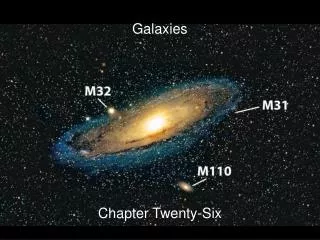
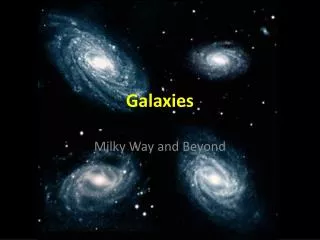
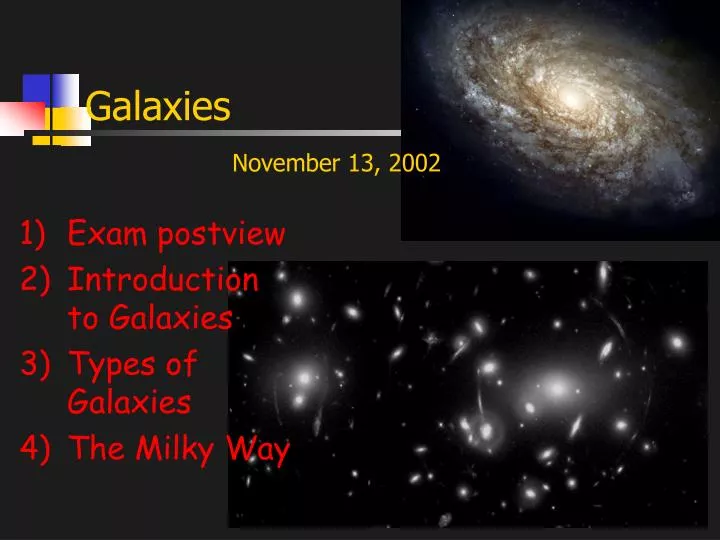
Galaxies • Galaxies are large collections of stars • millions and billions of stars • The Milky Way is our own galaxy • There are hundreds of billions of galaxies in the Universe • Millions to hundreds of billions of stars in each galaxy
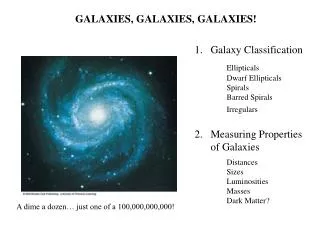
Types of Galaxies • Three main types of galaxies • based on shape • Spiral • rotating disk (with arms) • Elliptical • oval disk of stars • more chaotic motion • Irregular • none of the above
Active Galactic Nuclei • Some galaxies have supermassive black holes at the center • If material is falling into the black hole, enormous amounts of energy are released • accretion disk • Can shine with a luminosity of 1-100 million Suns! • Quasars are a type of AGN
Galaxy Collisions • Occasionally galaxies collide • don’t actually slam into each other • Passage of one galaxy through/near another causes major “stirring” • due to gravity • Causes new activity • star formation, AGNs,… Think of walking around before a football game
Looking at the Milky Way • Viewed as a bright band of star’s across the sky • Galactic center appears in the southern part of the sky (from the northern hemisphere • Much of the Milky Way is blocked by dust • dark band through the middle of the Milky Way • But we can study it in longer wavelengths • e.g. radio waves
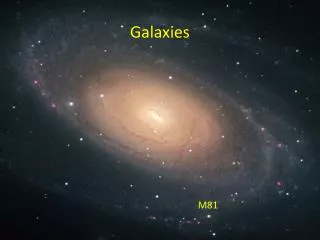
Spiral Galaxies • Spiral arms are a natural consequence of some rotations • If gas/dust in a disk are rotating with the same speed, stuff further out will take longer to go around • it will lag behind
Pieces of a Spiral Galaxy • Disk • Arms • Bulge • barred? • black hole • Halo • Globular clusters
Globular Clusters • Groups of old stars in the galactic halo • may have around 500,000 stars • may be around 15 lightyears across • Formed before the galaxy • or at very early stages • Orbiting the galaxy • No new star formation going on • Useful for studying the distribution of material in the galaxy • from gravity
Rotation Speeds of Galaxies • Most of the visible material of a galaxy is near the center • material thins out as you move outward • For spiral galaxies, this means stars farther out should be moving slower • But we see them all moving with the same speed! • must have an explanation Dark Matter!