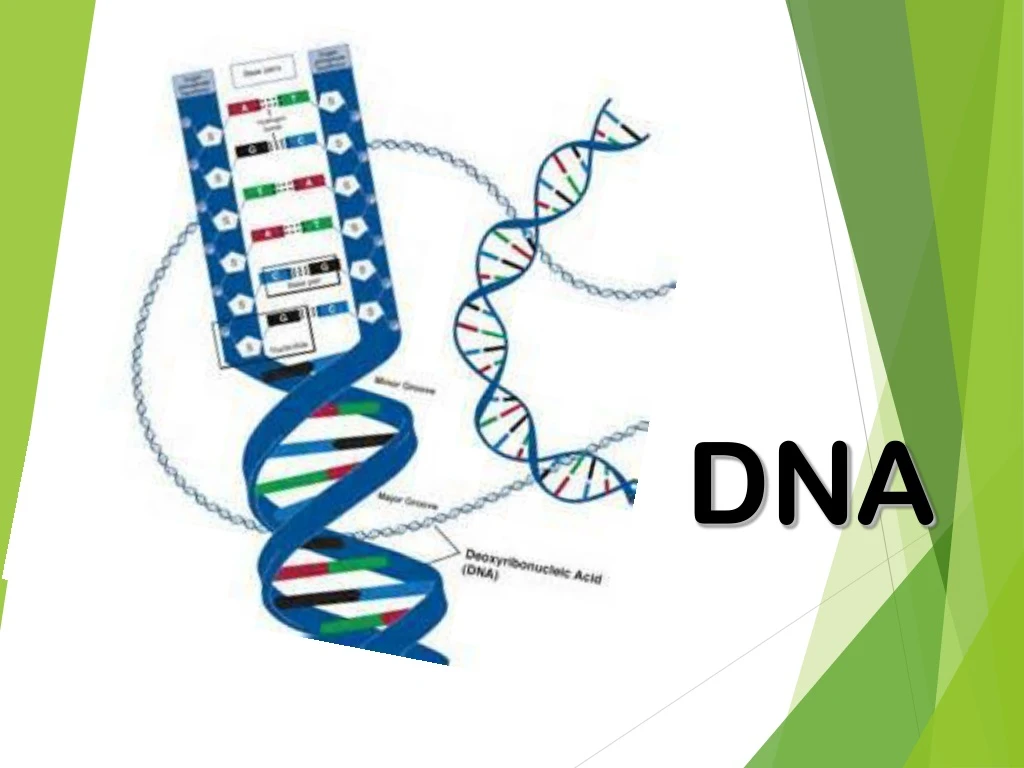

DNA
E N D
Presentation Transcript
History • Genetics is the study of genes. • Inheritance is how traits, or characteristics, are passed on from generation to generation. • Chromosomes are made up of genes, which are made up of DNA. • Genetic material (genes,chromosomes, DNA) is found inside the nucleus of a cell. • Gregor Mendel is considered “The Father of Genetics"
History • Rosalind Frankilin was the first person to discover DNA. • But, Watson and Crick were given the Nobel Peace Prize for the discovery of DNA’s double helix.
DNA • DNA is often called the blueprint of life. • In simple terms, DNA contains the instructions for making proteins within the cell.
Why do we study DNA? We study DNA for many reasons: • its central importance to all life on Earth • medical benefits such as cures for diseases • better food crops.
Chromosomes and DNA • Chromosomes are made up of genes. • Genes are made up of a chemical called DNA.
The Nucleus • DNA is located in the nucleus
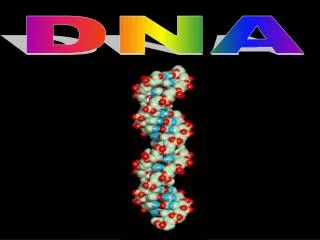
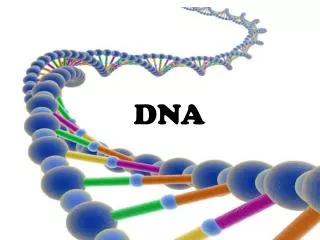
The Shape of the Molecule • DNA is a very long molecule. • The basic shape is like a twisted ladder or a spiral staircase. • This is called a double helix.
OneStrand of DNA phosphate • DNA is made up of the following molecules: phosphate and deoxyribose (sugar), and bases. • These fit together like puzzle pieces. deoxyribose bases
The Double Helix Molecule • The DNA double helix has two strands twisted together. • (In the rest of this unit we will look at the structure of one strand.)
O -P O O -P O O -P O O O O O O O C C ribose Nucleotides Nitrogenous base Ribose (sugar) + phosphate + base= nucleotide. O Phosphate C C C Deoxyribose O
The Basics • Each side of the ladder is made up of nucleic acids. • The backbone is a phosphate and a sugar • The rung of the ladder is the nitrogen base.
Fournitrogenous bases DNA has four different bases: • Cytosine C • Thymine T • Adenine A • Guanine G
Types of nitrogen bases • A= adenine • G= guanine • C= cytosine • T= thymine
O N C O C C C N C N N C C C N N C C N • When making hydrogen bonds, cytosine always pairs up with guanine, • And adenine always pairs up with thymine. • (Adenine and thymine are shown here.)
Two Stranded DNA • Remember, DNA has two strands that fit together something like a zipper. • The teeth are the nitrogenous bases but why do they stick together?
Important Adenine and Thymine always join together A -- T Cytosine and Guanine always join together C -- G
RNA- Ribonucleic acid • Single stranded!! • In RNA Thymine is replaced by Uracil • A-U (RNA) • not • A-T (DNA)
IF the DNA strand is GTACCAGATTAGC • What would the RNA strand be?
Copying DNA • Step 1- DNA unwinds and unzips • Step 2- Once the molecule is separated it copies itself. • The new strand of DNA has bases identical to the original
Transcription • When a secretary transcribes a speech, the language remains the same. However, the form of the message changes from spoken to written
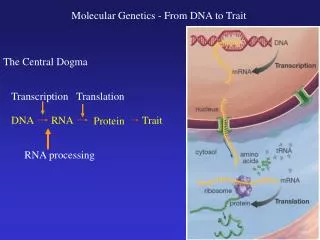
Transcription • Transcription- RNA is made from a DNA template in the nucleus. • This type of RNA is called messenger RNA or mRNA
Transcription • DNA is protected inside the nucleus. • mRNA carries the message of DNA into the cytoplasm to the ribosome's
Translation • To translate English into Chinese requires an interpreter. • Some person must recognize the worlds of one language and covert them into the other.
tRNA Transfer RNA • Happens in the ribosomes • The cells interpreter (transfer RNA) • tRNA translated the three-letter codons of mRNA to the amino acids that make up protein.
Translation • Genetic translation converts nucleic acid language into amino acid language.
Codon • The flow of information from gene to protein is based on codons. • A codon is a three-base word that codes for one amino acid
The flow of information from gene to protein is based on codons.
Mutations • A mutation occurs when there is a change in the order of the bases in an organism’s DNA. • Mutations can happen due to physical or chemical agents called mutagens. • Examples of mutagens: X-Rays, UV radiation, and chemicals
Mutations • Mutations can be helpful, harmful, or have no effect at all.
3 types of Mutations • Substitution • Insertion • Deletion
Substitution • This happens when one base is substituted for another base. • Example: • Original DNA strand: AATGGAT • Mutated Strand: AAGGGAT
Deletion • This happens when one base it deleted from the original DNA strand. • Example: • Original DNA strand: AATGGAT • Mutated Strand: AATGAT
Insertion • This happens when a base is added to the original DNA strand. • Example: • Original DNA strand: AATGGAT • Mutated Strand: AATTGGAT