Download
1 / 10
100 likes | 211 Vues
This section focuses on the properties and theorems related to isosceles and equilateral triangles. It presents key concepts such as the Isosceles Triangle Theorem, which states that if two sides of a triangle are congruent, the angles opposite those sides are also congruent. The Converse Theorem is also highlighted, along with the bisector properties of isosceles triangles. Furthermore, it introduces equilateral triangles, discussing their characteristic of being equiangular. Various applications and algebraic problems related to these triangle types are also included for practice.

E N D
4.5 Isosceles and Equilateral Triangles Chapter 4 Congruent Triangles
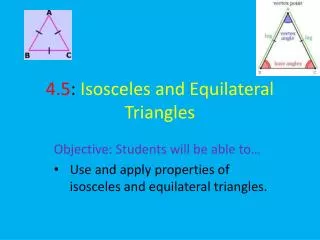
4.5 Isosceles and Equilateral Triangles Isosceles Triangle: Vertex Angle Leg Leg Base Angles Base *The Base Angles are Congruent*
Isosceles Triangles • Theorem 4-3 Isosceles Triangle Theorem If two sides of a triangle are congruent, then the angles opposite those sides are congruent B <A = <C A C
Isosceles Triangles • Theorem 4-4 Converse of the Isosceles Triangle Theorem If two angles of a triangle are congruent, then the sides opposite those angles are congruent B Given: <A = <C Conclude: AB = CB A C
Isosceles Triangles • Theorem 4-5 The bisector of the vertex angle of an isosceles triangle is the perpendicular bisector of the base B Given: <ABD = <CBD Conclude: AD = DC and BD is ┴ to AC A C D
Equilateral Triangles • Corollary: Statement that immediately follows a theorem Corollary to Theorem 4-3: If a triangle is equilateral, then the triangle is equiangular Corollary to Theorem 4-4: If a triangle is equiangular, then the triangle is equilateral
Using Isosceles Triangle Theorems Explain why ΔRST is isosceles. T U Given: <R = <WVS, VW = SW Prove: ΔRST is isosceles R W V VW = SW Given S <V = <S Base angles are congruent in an isosceles triangle <V = <R Given <R = <S Transitive or Substitution Property If base angles are congruent, then the sides opposite them are congruent. RT = TS ΔRST is isosceles Two sides are congruent, definition of isosceles triangle
Using Algebra Find the values of x and y: M ) ) y° Because <LMO = <NMO, MO is An angle bisector of isosceles triangle LMN. This makes it a perpendicular bisector, so x = N x° O 63° 90° L To solve for y: <N is 63° because it is an isosceles triangle. So… 27° 180 – 63 – 63 = 54° 54°/2 =
Landscaping A landscaper uses rectangles and equilateral triangles for the path around the hexagonal garden. Find the value of x. (n – 2)180 (6 – 2)180 x° 4(180) 720 720/6 120 *60 + 90 + 90 + 120 = 360*
Practice • Pg 213 1-16, 21-26