Naming Hydrocarbons
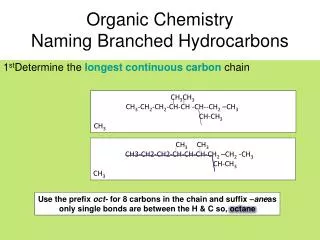
Naming Hydrocarbons. The following four IUPAC rules are applied in naming the branched-chain alkanes. Determine the longest continuous (not necessarily straight) chain of carbon atoms. The base name corresponds to the number of carbon atoms in the longest chain. (see Table 24.5)


Naming Hydrocarbons
E N D
Presentation Transcript
Naming Hydrocarbons • The following four IUPAC rules are applied in naming the branched-chain alkanes. • Determine the longest continuous (not necessarily straight) chain of carbon atoms. • The base name corresponds to the number of carbon atoms in the longest chain. (see Table 24.5) • The full name for the alkane will include the names of any branches.
Naming Hydrocarbons • The following four IUPAC rules are applied in naming the branched-chain alkanes. • Determine the longest continuous (not necessarily straight) chain of carbon atoms.
Naming Hydrocarbons • The following four IUPAC rules are applied in naming the branched-chain alkanes. • Any chain branching off the longest chain is named as an alkyl group. • Table 24.6 lists some alkyl groups.
Naming Hydrocarbons • The following four IUPAC rules are applied in naming the branched-chain alkanes. • The complete name of a branch requires a number that locates the branch on the longest chain. • Always number from the end of the longest chain closest to the first branch.
Naming Hydrocarbons • The following four IUPAC rules are applied in naming the branched-chain alkanes. • The complete name of a branch requires a number that locates the branch on the longest chain. 2-methylhexane
Naming Hydrocarbons • The following four IUPAC rules are applied in naming the branched-chain alkanes. • When there are more than one alkyl branch of the same kind, this number is indicated by a prefix, such as di-, tri-, tetra-, used with the name of the alkyl group. • The position of each group on the longest chain is given by numbers.
Naming Hydrocarbons • The following four IUPAC rules are applied in naming the branched-chain alkanes. • When there are more than one alkyl branch of the same kind, this number is indicated by a prefix, such as di-, tri-, tetra-, used with the name of the alkyl group. 3,4-dimethylhexane
Naming Hydrocarbons • The following four IUPAC rules are applied in naming the branched-chain alkanes. • When there are two or more different branches, the name of each branch, with its position number, precedes the base name. • The branch names are placed in alphabetical order.
Naming Hydrocarbons • The following four IUPAC rules are applied in naming the branched-chain alkanes. • When there are two or more different branches, the name of each branch, with its position number, precedes the base name. 3-ethyl-2-methylpentane
Nomenclature of Alkenes and Alkynes • The following four IUPAC rules are applied in naming the branched-chain alkenes and alkynes. • The rules are essentially the same as those for alkanes, except that names end in –ene for alkenes and –yne for alkynes. • The position of the double (or triple) bond is indicated in the name by bond position number.
Nomenclature of Alkenes and Alkynes • The following four IUPAC rules are applied in naming the branched-chain alkenes and alkynes. 3-methyl-1-pentene
Nomenclature of Alkenes and Alkynes • The following four IUPAC rules are applied in naming the branched-chain alkenes and alkynes. • Recall that alkenes also exhibit cis and trans isomerism and so either cis or trans must be included in the name.
Derivatives of Hydrocarbons • A functional group is a reactive portion of a molecule that undergoes predictable reactions. • Table 24.7 lists some common organic functional groups. • In the previous sections we discussed the hydrocarbons and their reactions. • All other organic compounds can be considered to be derivatives of hydrocarbons.
Organic Compounds Containing Oxygen • Many of the important functional groups in organic compounds contain oxygen. • Examples are • alcohols • ethers • aldehydes • ketones • carboxylic acids • esters
Some examples are methanol ethanol 2-propanol Organic Compounds Containing Oxygen • An alcohol is a compound obtained by substituting a hydroxyl group (-OH) for an –H atom on a carbon atom of a hydrocarbon group.
An example is diethyl ether Organic Compounds Containing Oxygen • An ether is a compound with an oxygen “bridge” between two alkyl groups. • This is the most common ether, often called simply ether, used as an anesthetic.
An example is ethanal Organic Compounds Containing Oxygen • An aldehyde is a compound containing a carbonyl group with at least one H atom attached to it.
An example is 2-butanone Organic Compounds Containing Oxygen • A ketone is a compound containing a carbonyl group with two hydrocarbon groups attached to it.
An example is ethanoic acid Organic Compounds Containing Oxygen • A carboxylic acid is a compound containing the carboxyl group, -COOH.
The general structure is Organic Compounds Containing Oxygen • An ester is a compound formed from a carboxylic acid, RCOOH, and an alcohol, R’OH.
primary amine secondary amine tertiary amine Organic Compounds Containing Nitrogen • Most organic bases are amines, which are compounds that are structurally derived by replacing one or more hydrogen atoms of ammonia with hydrocarbon groups.
Organic Compounds Containing Nitrogen • Most organic bases are amines, which are compounds that are structurally derived by replacing one or more hydrogen atoms of ammonia with hydrocarbon groups. • Table 24.9 lists some common amines.
The general formula for a common amide is Organic Compounds Containing Nitrogen • Amides are compounds derived from the reaction of ammonia, or of a primary or secondary amine, with a carboxylic acid.
Operational Skills • Writing a condensed structural formula • Predicting cis-trans isomers • Predicting the major product of an addition reaction • Writing the IUPAC name of a hydrocarbon given the structural formula, and vice versa