The Yalta Conference: Birth of the Cold War and Shifting Alliances
100 likes | 232 Vues
The Yalta Conference in 1945 brought together Roosevelt, Churchill, and Stalin to address post-war Europe and laid the groundwork for Cold War tensions. Key agreements included the division of Germany into four zones of control and the controversial establishment of a communist government in Poland. While the Declaration of Liberated Europe promised self-determination, Soviet actions in Eastern Europe undermined this principle and escalated hostilities. The Yalta Conference marked a pivotal moment, signaling an ideological divide between the U.S. and the Soviet Union that defined global relations until the Cold War's end.


The Yalta Conference: Birth of the Cold War and Shifting Alliances
E N D
Presentation Transcript
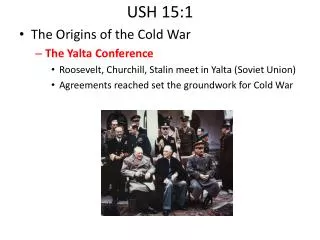
USH 15:1 • The Origins of the Cold War • The Yalta Conference • Roosevelt, Churchill, Stalin meet in Yalta (Soviet Union) • Agreements reached set the groundwork for Cold War
Issues at Yalta • Poland • Two governments-in-waiting • Communist and Democratic • Stalin argues Poland must be communist because it is a neighbor country • Churchill and Roosevelt reluctantly agree
Issues at Yalta • The Declaration of Liberated Europe • “The right of all people to choose the form of government under which they will live”
Issues at Yalta • Dividing Germany • Divide Germany into four zones • Great Britain, U.S., France, Soviet Union would each control a zone • Stalin demands Germany pay war reparations • Roosevelt agrees, with stipulations: • Germany will pay in goods, not cash • Germany will pay what it can afford
Issues at Yalta • Tensions Rise After Yalta • Soviets (Russians) pressure king of Romania to appoint a communist gov’t • U.S. accuses Soviets of violating “Declaration of Liberated Europe” • Soviets refuse to allow non-Communists serve in Polish government
The Cold War • Yalta marks turning point in U.S. – Soviet relations • Roosevelt: Allied victory + U.N. = peace • Instead: U.S. and Soviets become increasingly hostile and competitive with each other • Era known as “Cold War” • 1946-1990
Cold War • Soviet Goals and Ideals • Keep Germany weak • Control countries around Russia • Capitalism will eventually fail • Doing countries a favor by making them communist • Capitalist countries want to destroy communist countries
American Goals and Ideals • Economic growth is key to peace • World trade will stop world war • President Truman believed the appeasement of Hitler caused WWII • Would not appease future dictators
The Potsdam Conference • Truman meets Stalin in Germany • Stalin: • Germany must pay heavy reparations • Truman: • German industry must recover, or Europe will not recover • American/Soviet tensions increase further
The Iron Curtain • Communist countries in eastern Europe become “satellite nations” of Soviet Union • Remain friendly to Soviet Union • Follow Soviet policies • Churchill: an “iron curtain” has fallen over eastern Europe • Speech in Fulton, Missouri