Download

1 / 35
350 likes | 479 Vues
This overview of thermochemistry explores the fundamental concepts of energy, work, and heat transfer. Key principles include the definitions of potential and kinetic energy, the law of conservation of energy, and the first law of thermodynamics, emphasizing the constancy of energy in the universe. Specific heat calculations, calorimetry, and state functions are discussed, highlighting the distinctions between state functions and path-dependent quantities like work and heat. The principles of enthalpy, including Hess's Law and the thermodynamic processes of endothermic and exothermic reactions, are examined in detail.

E N D
Energy • The ability to do work or transfer heat. • Work: Energy used to cause an object that has mass to move. • Heat: Energy used to cause the temperature of an object to rise.
Definitions #1 Energy: The capacity to do work or produce heat Potential Energy: Energy due to position or composition Kinetic Energy: Energy due to the motion of the object
Definitions #2 Law of Conservation of Energy: Energy can neither be created nor destroyed, but can be converted between forms The First Law of Thermodynamics: The total energy content of the universe is constant
E = q + w E = change in internal energy of a system q = heat flowing into or out of the system -q if energy is leaving to the surroundings +q if energy is entering from the surroundings w = work done by, or on, the system -w if work is done by the system on the surroundings +w if work is done on the system by the surroundings
Work problemsChapter 5 • 5.25 • 5.27 A and B • 5.31 All
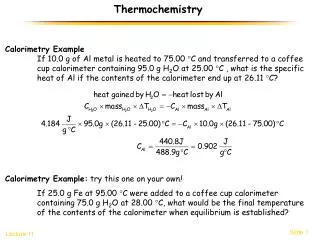
Calorimetry The amount of heat absorbed or released during a physical or chemical change can be measured… …usually by the change in temperature of a known quantity of water 1 calorie is the heat required to raise the temperature of 1 gram of water by 1 C 1 BTU is the heat required to raise the temperature of 1 pound of water by 1 F
The Joule The unit of heat used in modern thermochemistry is the Joule 1 joule = 4.184 calories
The amount of heat required to raise the temperature of one gram of substance by one degree Celsius. Specific Heat
Calculations Involving Specific Heat OR s = Specific Heat Capacity q = Heat lost or gained T = Temperature change
Problems • 5.53 a and B
State Functions depend ONLY on the present state of the system ENERGYIS A STATE FUNCTION A person standing at the top of Mt. Everest has the same potential energy whether they got there by hiking up, or by falling down from a plane! WORKIS NOT A STATE FUNCTION WHY NOT???
State Functions Usually we have no way of knowing the internal energy of a system; finding that value is simply too complex a problem.
State Functions • However, we do know that the internal energy of a system is independent of the path by which the system achieved that state. • In the system below, the water could have reached room temperature from either direction.
State Functions • Therefore, internal energy is a state function. • It depends only on the present state of the system, not on the path by which the system arrived at that state. • And so, E depends only on Einitial and Efinal.
State Functions • However, q and w are not state functions. • Whether the battery is shorted out or is discharged by running the fan, its E is the same. • But q and w are different in the two cases.
Work When a process occurs in an open container, commonly the only work done is a change in volume of a gas pushing on the surroundings (or being pushed on by the surroundings).
Work We can measure the work done by the gas if the reaction is done in a vessel that has been fitted with a piston. w = −PV
Work, Pressure, and Volume Compression Expansion +V (increase) -V (decrease) -w results +w results Esystemdecreases Esystemincreases Work has been done on the system by the surroundings Work has been done by the system on the surroundings
Energy Change in Chemical Processes Endothermic: Reactions in which energy flows into the system as the reaction proceeds. + qsystem - qsurroundings Exothermic: Reactions in which energy flows out of the system as the reaction proceeds. - qsystem + qsurroundings
Enthalpy • If a process takes place at constant pressure (as the majority of processes we study do) and the only work done is this pressure-volume work, we can account for heat flow during the process by measuring the enthalpy of the system. • Enthalpy is the internal energy plus the product of pressure and volume: H = E + PV At constant pressure and volume the change in enthalpy is the heat gained or lost H = q
Enthalpies of Reaction The change in enthalpy, H, is the enthalpy of the products minus the enthalpy of the reactants: H = Hproducts−Hreactants
Enthalpies of Reaction This quantity, H, is called the enthalpy of reaction, or the heat of reaction.
Problems 5.57 A and B
Hess’s Law “In going from a particular set of reactants to a particular set of products, the change in enthalpy is the same whether the reaction takes place in one step or a series of steps.”
Hess’s Law Example Problem CH4 C + 2H2 +74.80 kJ Step #1: CH4 must appear on the reactant side, so we reverse reaction #1 and change the sign on H.
Hess’s Law Example Problem CH4 C + 2H2 +74.80 kJ C + O2 CO2 -393.50 kJ Step #2: Keep reaction #2 unchanged, because CO2 belongs on the product side
Hess’s Law Example Problem CH4 C + 2H2 +74.80 kJ C + O2 CO2 -393.50 kJ 2H2 + O2 2 H2O -571.66 kJ Step #3: Multiply reaction #2 by 2
Hess’s Law Example Problem CH4 C + 2H2 +74.80 kJ C + O2 CO2 -393.50 kJ 2H2 + O2 2 H2O -571.66 kJ CH4 + 2O2 CO2 + 2H2O -890.36 kJ Step #4: Sum up reaction and H
Calculation of Heat of Reaction Hrxn = Hf(products) - Hf(reactants) Hrxn = [-393.50kJ + 2(-285.83kJ)] – [-74.80kJ] Hrxn = -890.36 kJ