Understanding Food, Water, Minerals, and Pollution Management
This comprehensive overview covers key concepts related to food production, water usage, mineral resource management, and pollution control. It highlights the impact of industrialized agriculture, the significance of water resources, the environmental effects of mining, and the importance of integrated waste management strategies to improve sustainability. The document examines issues such as soil erosion, water pollution, and waste reduction, emphasizing effective approaches to manage natural resources responsibly for future generations.

Understanding Food, Water, Minerals, and Pollution Management
E N D
Presentation Transcript
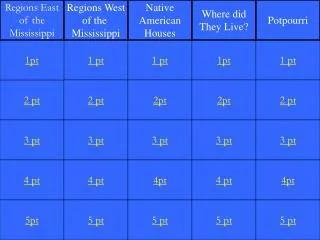
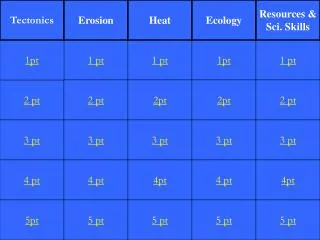
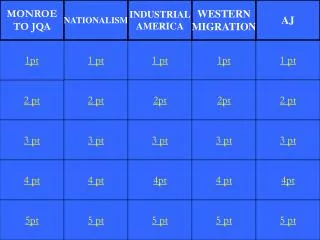
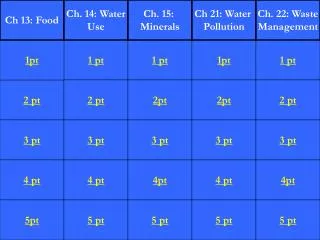
Ch 13: Food Ch. 14: Water Use Ch. 15: Minerals Ch 21: Water Pollution Ch. 22: Waste Management 1pt 1 pt 1 pt 1pt 1 pt 2 pt 2 pt 2pt 2pt 2 pt 3 pt 3 pt 3 pt 3 pt 3 pt 4 pt 4 pt 4pt 4 pt 4pt 5pt 5 pt 5 pt 5 pt 5 pt
A type of agriculture that requires large amounts of fossil fuels, pesticides, fertilizers and water
Saltwater intrustion, subsidence and aquifer depletion are all effects of the overuse of ______ water
It is most economical and environmentally sound to focus water management efforts on
The time it takes to use up 80% of a mineral reserve at current use rates is known as
Mining a high-grade ore would cause more/ less environmental damage than mining a low-grade ore
What is collapse of land, acid mine drainage, emissions of toxic chemicals, spoils heaps
A class of pollutants that can lead to excessive growth of algae
The law that was put in place in response to the Love Canal incident
The US, with 5% of the world’s population produces ____ of the world’s trash
Trash produced by households and businesses accounts for _% of the US trash production
In a low-waste approach, this approach would be given the least priority