Understanding Circuit Protection: Fuses, Breakers, and Testing Techniques
This comprehensive guide covers circuit protection components, including various types of fuses, their installation and testing methods. Learn about auto-fuses, mini and maxi fuses, as well as fusible links and circuit breakers. Understand the importance of correct fuse sizing using Watt's law to ensure optimal protection. Discover testing techniques for electronic devices, including relays and solenoids, and how to diagnose circuit defects. This essential information is crucial for both DIY enthusiasts and professionals in electrical work.

Understanding Circuit Protection: Fuses, Breakers, and Testing Techniques
E N D
Presentation Transcript
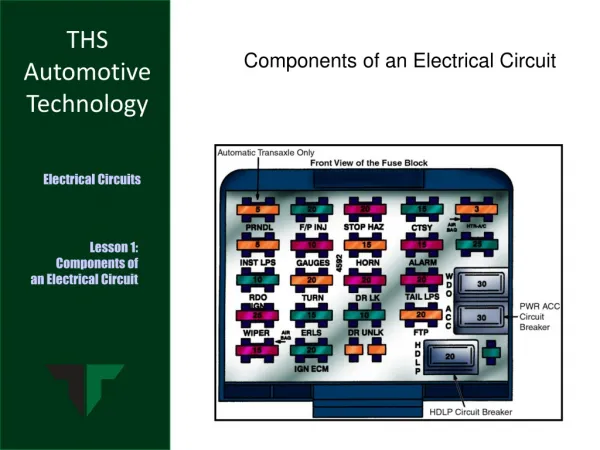
Circuit Protection • Types of Fused Protection How to pull them
Fuses • Auto-fuse (blade type and Color coded) • Mini-fuse • Maxi-fuse A. TEST HOLES B. REMOVAL
Maxi-fuses • Combination blade / cartridge • Protects main circuits • Safer than fusible link • Cover fewer circuits than a fusible link • Often in Power Distribution box
Ceramic and Glass • Rated by current failure level • Three letter code for type and size • Glass style replaces ceramic • Caution in pulling
Two reasons for blowing Where do they blow? Why?
New Circuits ? • What size of fuse should I install? • Use Watts law. Watts divided by volts
FUSIBLE LINKS • Lighter gauge wire than main conductor • Covered with special insulation • Protect Main circuits • Usually under hood
Fusible Links Repair • Location • Circuits protected • Insulation • Visual checks • Installing a new link • 4 wire sizes smaller (4 numbers larger) • Soldering
Fuses Male Pal fuses Female Pal fuses Bolt on Pal Fuses
Circuit Breaker • Why circuit breakers • Styles • Deterioration
TESTING CIRCUIT PROTECTION DEVICES • Must inspect closely • Type of failure determines cause • Best to use DVOM • Do not overload circuit by installing to large of fuse or tin foil • Connections must be tight • Do not use un-fused jumper wire
Switches • Controls electrical current (N.O. or N.C.) • Single-pole, single throw (SPST) • Momentary Switch • Single-pole, double throw switch (SPDT) • Ganged Switch
Relays • Electromagnetic Switches (Relays) • Two Circuits • Control Circuit • Load Circuit • Magnetic field operates contacts • Late model relays are universal
TESTING RELAYS • Can use several methods to test • Must Check both circuits • Be careful using test light if relay is operated by computer • Can bench test if needed • Some relays have schematic on them • Must be correct resistance
SOLENOIDS • Electromagnetic device with a iron core • Does mechanical work • Core is moveable and does work • Can test with DVOM
STEPPED RESISTORS • Usually used to control fan motor speeds • Resistance is changed by control of switch • Controls current to change speeds • Thermal fuse
Variable Resisters • Rheostats • Two terminals • Higher current • Potentiometer • Three terminals • Lower current • Many uses for variable types
The three types of circuit defects are: • Shorts • Grounds • Opens • poor connections
TESTING FOR CIRCUIT DEFECTS • DVOM IS BEST TO USE! • Must know circuit operation before can diagnose problem • Must know how to use equipment and which equipment to use.