Comprehensive Substance Management Business Program
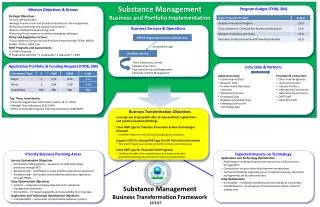
Implementing a budget for FY08 to manage chemicals, reduce risks, and prevent pollution. Strategic objectives include safe pesticides and reducing lead poisoning. Key initiatives include leveraging geospatial data and enhancing data accessibility.

Comprehensive Substance Management Business Program
E N D
Presentation Transcript
Substance Management Business and Portfolio Implementation Program Budget (FY08, $M) Mission Objectives & Drivers • Strategic Objectives: • Ensure safe pesticides; • Manage chemical risks and provide leadership on risk management; • Promote partnerships and pollution prevention; • Reduce childhood lead poisoning; and • Ensure technical expertise to address emerging challenges • Policy and Regulatory Drivers: • Toxic Substance Control Act and Pollution Prevention Act; FIFRA, AHERA, ASHAA , FFDCA, FQFA, ESA • PART Programs and Assessments: • 12 PART Programs • 5 moderately effective 1 inadequate 5 adequate 1 RND Business Services & Operations OPPTS Organizational Goals/Objectives Achieved through Business Service Toxic Substances Control Pollution Prevention Pesticides Review and Registration Chemical and Risk Management Application Portfolio & Funding Request (FY08, $M) Core Data & Partners • Providers & Consumers • Other Federal Agencies • Local Communities • Industry Partners • International Community • State/local Governments • OPPT Staff • Other EPA Staff • Substances Data • Environmental Data • Research Data • Human Health Data (lead, chemical) • Substance Exposure • Geospatial Data • Regulatory/Scientific Data • Emerging science and Technology data • Top Three Investments: • Pesticide Registration Information System (3.75 DME) • Manage Toxic Substances (2.81 DME) • Office of Pesticide Programs Information Network (0.00 DME) Business Transformation Objectives Leverage use of geospatial data to map pesticide registrations and justify evaluations/findings • Close PART gap for Pollution Prevention & New Technologies Research • Establish long term and annual strategic goals and plans • Support OECA in closing PART gap for EPA Pesticide Enforcement • Work with Regions and states to better enforce pesticides laws • Close PART gap for Pesticide Field Programs • Collaborate with other organizations and improve worker protection/training to promote the safe use of pesticides Priority Business Planning Areas Expected Impacts on Technology • Application and Technology Optimization • Performance– improved system performance for eIUR processes through MTS • Connectivity– secure connectivity between workstations • Technical Standards-improved use of standards (scanning, document management) set by other solutions • Data Optimization • Accessibility – increased availability and accessibility of critical data • Standardization – development of nomenclature where it doesn’t already exist • Service Optimization Objectives • Performance Management – evaluation of eIUR automated processes through MTS • Reengineering – modification of new chemical submission operations • Reengineering – standardize and streamline pesticides registration through PRISM • Data Optimization Objectives • Content – integration of legacy data stores for substance management operations • Accessibility – Increased availability and accessibility of critical data • Application and Technology Optimization Objectives • Interoperability – automated communication between systems Substance Management Business Transformation Framework 12/5/07