Enhancing Learning Through Multi-User Virtual Environments: River City and Whyville
90 likes | 213 Vues
Discover the transformative power of Multi-User Virtual Environments (MUVEs) in education, exemplified by River City and Whyville. In River City, students navigate a 1800s river town as avatars to investigate health crises through inquiry-based learning. Meanwhile, Whyville serves as an interactive online forum where students explore disease spread. Both MUVEs foster collaboration and critical thinking, ensuring a hands-on learning experience while teachers guide students in their inquiries. Addressing challenges like access and parental skepticism, these innovative platforms significantly boost engagement and understanding in biological concepts.


Enhancing Learning Through Multi-User Virtual Environments: River City and Whyville
E N D
Presentation Transcript
Learning in Another World By: Dustin Smith
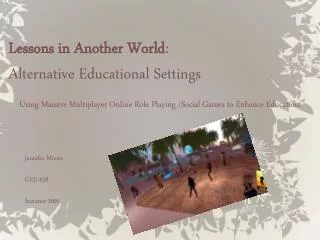
What’s a MUVE? • -multi-user virtual environment • -online simulation of a geographical location • -students navigate an avatar around an environment similar to a SIMS game in order to learn
River City • Leading educational MUVE • Created by several professors from a group of universities • Virtual Reality • -students gather data to determine the cause of health crisis • students work through their avatars to interview inhabitants of an 1800’s river town and explore the geographical terrain to determine the source of the medical problem • -students are able to interact with other students in other school systems to develop a theory for what is causing the disease in River City
Making an Impact • -Not All Fun and Games • -parents are skeptical of the technology because they are unsure to what extent their children are interacting with others • -controls are setup to monitor chatting and email activity • -professors monitor the chat areas to ensure there are no inappropriate activities going on inside the chat room • some children may not have access to a computer at their home • -teachers help these students find access to the internet at public libraries • -teachers help these students find access to the internet in computer labs on campus
-2004-2005 Integrative Technology Research • -Students introduced to Whyville technology showed improvement in biology • -after the study, students showed a 32%-35% increase of knowledge of biology using the Whyville technology • students learned inquiry-based learning by using the technology based on their responses to how and why the disease spread throughout the community • absenteeism decreased after integrating Whyville into lesson plans
Next Stop: Whyville • -open internet forum • -students used Whyville to learn how disease spread • -interactive, avatar driven environment
Who, What, and Whyville • -Teacher as the guide • -teachers are guides rather than answer givers • -teachers become more proficient at inquiry-based learning and teachers teach students by allowing them to ask and answer their own questions • Students learn to teach themselves and each other by interacting within the virtual environment
Why I Would Use Whyville It encourages inquiry-based learning, which is essential for teaching biology It forces students to discuss problems and ideas within the virtual world and elicits class discussion
References • Blaisdell, M. (2006). Educational gaming: all the right MUVEs. The Journal. Retrieved February 2, 2010. <http://thejournal.com/articles/2006/09/01/educational-gaming--all-the-right-muves. • http://www.youtube.com/watch?v=xcNP7xjWKk4 • www.whyville.com