
SlideServe
Menu
Préférences
© SlideServe · v2026

In-Situ Observations of Hydrodynamics and Wave Dynamics at New River Inlet

holly-wynn avatar
27 diapositives · 380 Views · Nov 06, 2014

This study presents comprehensive in-situ observations of currents, waves, and pressure levels at New River Inlet. Measurements include current profiles, bottom pressure impacts, and wave dynamics from various locations. Key findings reveal interactions between wave heights and direction shifts affecting ebb jets, as well as strong dissipation patterns at the outer shoals. Results emphasize the significance of wave-driven dynamics in subtidal flow behavior, the influence of wind stress, and depth-averaged momentum balances essential for understanding inlet hydrodynamics.
In-Situ Observations of Hydrodynamics and Wave Dynamics at New River Inlet - slide 1
01 / 27In-Situ Observations of Hydrodynamics and Wave Dynamics at New River Inlet
1 / 17

Télécharger la présentation

In-Situ Observations of Hydrodynamics and Wave Dynamics at New River Inlet
Une image / un lien ci-dessous est fourni (tel quel) pour télécharger la présentation

Politique de téléchargement : le contenu du site vous est fourni TEL QUEL pour votre information et votre usage personnel ; il ne peut être vendu, concédé sous licence ni partagé sur d’autres sites sans l’accord de son auteur.Le contenu vous est fourni TEL QUEL, pour votre information et votre usage personnel uniquement. Téléchargez la présentation en cliquant sur ce lien. Lors du téléchargement, si vous ne parvenez pas à télécharger une présentation, l’éditeur a peut-être supprimé le fichier de son serveur.Pendant le téléchargement, si vous ne parvenez pas à obtenir une présentation, le fichier a peut-être été supprimé par l’éditeur.

F I N

Plus de contenu associé

Transcription de la présentation
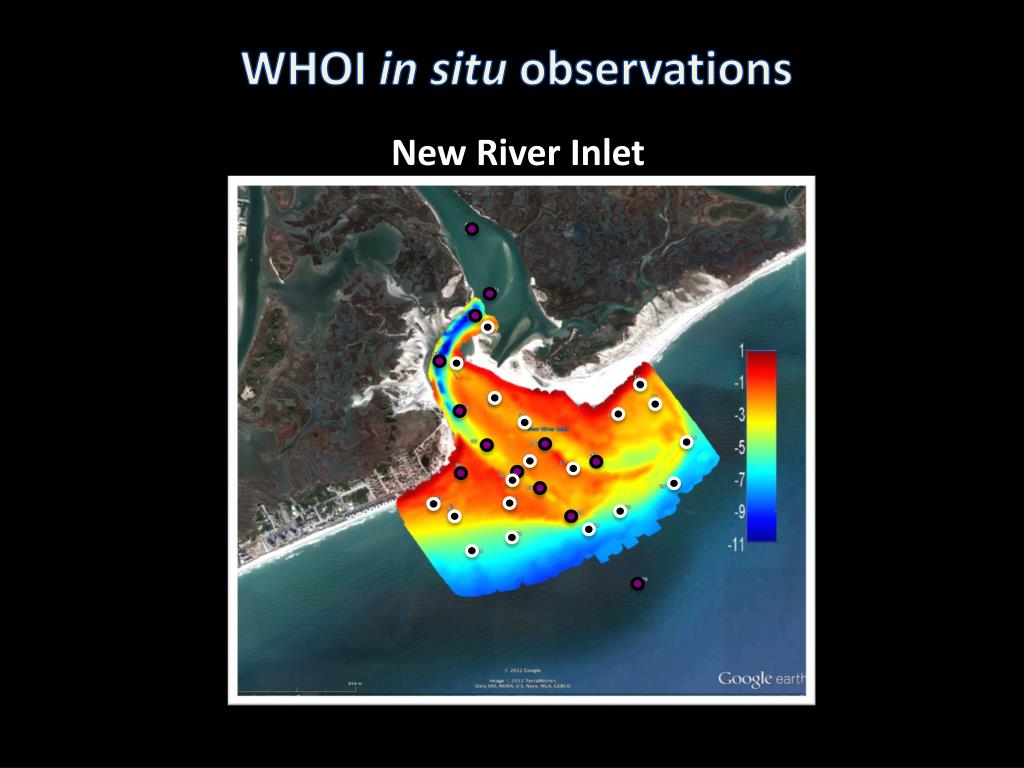
  1. WHOI in situ observations New River Inlet

  2. Measurements: Current profilers in channels = 1 min average mean flows ADV on and offshore of shoals = 2 Hz near-bottom flows 8.5-min estimates of wave heights 0.005 < f < 0.300 Hz 1-hr estimates of wave directions Bottom pressure used for 8.5-min estimates of mean water levels

  3. Measurements: Current profilers in channels = 1 min average mean flows ADV on and offshore of shoals = 2 Hz near-bottom flows 8.5-min estimates of wave heights 0.005 < f < 0.300 Hz 1-hr estimates of wave directions Bottom pressure used for 8.5-min estimates of mean water levels Acoustic surface tracking at 3 locations provides 4 Hz surface fluctuations

  4. Measurements: Current profilers in channels = 1 min average mean flows ADV on and offshore of shoals = 2 Hz near-bottom flows 8.5-min estimates of wave heights 0.005 < f < 0.300 Hz 1-hr estimates of wave directions Bottom pressure used for 8.5-min estimates of mean water levels Acoustic surface tracking at 3 locations provides 4 Hz surface fluctuations Cross-section flow profiles in inlet on May 7, 11, 14, and 21

  5. Wave heights and directions Strong wave dissipation at outer edge of edge shoal

  6. Wave heights and directions Strong wave dissipation at outer edge of edge shoal Flows on outer shoals sometimes tide dominated and sometimes wave dominated

  7. Ebb flows primarily in 2 “jets” & flood flows funnel into inlet Julie & Tom: Simulations suggest waves affect direction of ebb jet

  8. Subtidal flows offshore for SMALL waves & onshore for BIG waves 15 cm/s Anna: Results suggest waves are important to subtidal flows: Balance between pressure gradient, bottom stress, waves

  9. Along-channel flows ~ depth-uniform flood ebb

  10. Along-channel flows ~ depth-uniform Except near Topsail during flood … eddy?? flood Vertical shear ebb

  11. Compare with remotely-sensed estimates of surfacecurrents? Along-inlet distance (m) 1 0.5 Velocity (m/s) Velocity increases towards Topsail (west) 0 offshore -400 -200 0 200 Along-inlet distance (m)

  12. May 21 May 7, 11, 14

  13. Stream-normal (lateral) circulation Little lateral flow

  14. Stream-normal (lateral) circulation Topsail Onslow surface seafloor flood ebb Little lateral flow

  15. Topsail Onslow Stream-normal (lateral) circulation 15 cm/s surface seafloor flood ebb Topsail Onslow surface seafloor flood ebb Little lateral flow

  16. Sub-tidal cross-inlet flows Wind & surface layer: r2 = 0.6 Wind & bottom layer: r2= 0.6 Flow to east Wind velocity (max 10 m/s) Cross-channel flow velocity (m/s) Elevation (mab) Flow to west

  17. Water surface tilts reflect surface flows and convergences Flood (major-axis flows) Sea surface level (cm) Water depth (m) Flood (minor-axis flows) Can the surface elevation be measured remotely?

  18. Wave dissipation on outer shoal • Role of currents (Zippel & Thomson)? • Flows on shoal may be wave or tide driven • Waves shift ebb jet direction • Waves enhance flood flows • Eddy near Topsail? • Two-layer cross-channel flows in inlet • Tidal flows around bend • Winds • Surface elevation reflects flow structure

  19. Into inlet Along-channel flows (m/s) Tropical storm Beryl Out of inlet Tropical storm Alberto Nor’easter Significant wave height (m)

  20. Instrument array plan Current profiler Current meter Pressure gage Current profiler colocated with pressure gage Depth (m relative to msl) Shallow Current meter colocated with pressure gage Bathymetry data provided by Jesse McNinch and the staff of the US Army Corps of Engineers Field Research Facility. Deep 1 km

  21. Research plan: Alongshore dynamics at inlet mouth Flow to northeast Wave forcing Wind Forcing Bed Stress Distance above the bottom (m) Cross- inlet flow velocity (m/s)

  22. Cross-channel subtidal momentum balance Wind & bottom stress: r2 = 0.6 Waves & bottom stress: r2= 0.5 1 0 Forcing (m2s-2 x 10⁻⁴) Wave forcing Wind stress (O(10 m/s)) to southwest -1 01 05 10 15 20 May 2012 Wind data from Jim Thomson

  23. Wave forcing Wind Forcing Bed Stress r2 = 0.5 2 wind + wave forcing Bottom Stress Cdv|U| Cd= 0.006 0 (m2s-2 x 10⁻⁴) to southwest -2 01 05 10 15 20 May 2012

  24. Research plan: Cross-inlet dynamics inside the inlet Introduction: • At idealized headlands during max ebb or flood: • Depth-avg. stream-normal pressure gradient • ≈ depth avg. centrifugal acceleration • [Hench et al., 2002] • This balance develops a ‘dome’ of water across the inlet, restricting lateral mixing to either side. Particle trajectories Hench and Luettich, 2003 Max. flood, Idealized Inlet II Hench et al., 2002 Cross-inlet

  25. Research plan: Cross-inlet dynamics inside the inlet Theory: Stream-normal momentum balance [vertical-avg. subtracted] [Kalkwijk and Booij, 1986; Geyer, 1993] (a) Local acceleration Stream-wise advection Centrifugal acceleration Vertical diffusion Wind stress Bottom stress Depth-averaged stream-normal momentum balance: [Hench and Luettich, 2003] (b) Wind stress Bottom stress Centrifugal acceleration Pressure gradient Cross-inlet