Download
1 / 4
40 likes | 159 Vues
This study investigates the contrasting detector dependence observed in the Dnorm and L/D approaches when analyzing vertex charge purity and efficiency. While notable detector dependence is present for the Dnorm approach, it is absent for L/D, which raises questions about potential issues with the SGV framework. By analyzing differences in track assignment and missed tracks between BRAHMS and SGV, we aim to uncover the underlying causes of these discrepancies. We propose a comparison of L/D distributions of missed tracks, emphasizing the relationship between track efficiency and detector resolution.

E N D
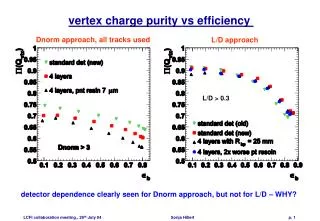
vertex charge purity vs efficiency Dnorm approach, all tracks used L/D approach L/D > 0.3 detector dependence clearly seen for Dnorm approach, but not for L/D – WHY?
detector dependence for L/D seen in the BRAHMS framework (Nicolo’s study) • its absence in SGV needs to be understood (might point to problem with SGV) • Strategy: • difference in Qvtx purity corresponds to difference in number of missed tracks • (= tracks from B decay according to MC information, but not assigned • by ZVTOP and track attachment) • find out, where this difference come from in BRAHMS, and compare with SGV • suggestion: compare the L/D distributions of missed tracks • would expect L/D value of a track to depend on detector resolution • then the slope of that distribution should change with detector (migration)
L/D distribution for missed tracks (SGV) L/D not evaluated (0 entered) for tracks failing track selection cuts (see next page) improved detector: efficiency 69.6% 4329 tracks missed (15.3% vertices affected if exactly 1 track/vtx missed) degraded detector: efficiency 67%, 4281 tracks missed (15.7%) 2 detectors compared cut value change in slope?
effect of track selection cuts (SGV) compare same detectors as before, i.e. an improved detector to a degraded one • for each cut one entry per track, • which it discards • ( > 1 entry / track possible ! ) • cut, which removes largest • number of tracks: • transverse momentum > 0.1 GeV • cut, which shows • largest detector dependence: • Rf impact parameter resolution