Understanding δ15N Dynamics: Denitrification, Gaseous Loss, and Nutrient Cycling in Terrestrial Ecosystems
70 likes | 197 Vues
This study explores the dynamics of δ15N signatures in various ecological contexts, including soils and vegetation, to assess denitrification fluxes and nitrogen loss mechanisms. Key hypotheses focus on nitrogen inputs, leaching, and gas loss, grounded in global observations and modeling efforts coupled with lab and field experiments. Our previous work highlights changes in δ15N with elevation in California, while planned studies aim to investigate new nitrogen compounds and isotope effects to enhance our understanding of nutrient cycling within hydrological systems.


Understanding δ15N Dynamics: Denitrification, Gaseous Loss, and Nutrient Cycling in Terrestrial Ecosystems
E N D
Presentation Transcript
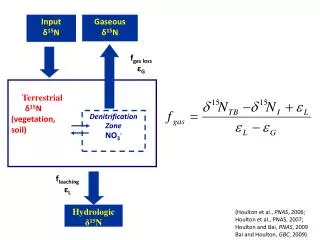
Input δ15N Gaseous δ15N I fgas loss εG G Terrestrial δ15N (vegetation, soil) Denitrification Zone NO3- fleaching εL L Hydrologic δ15N (Houlton et al., PNAS, 2006; Houlton et al., PNAS, 2007; Houlton and Bai, PNAS, 2009 Bai and Houlton, GBC, 2009)
Observation and modeling Global data Lab and field experiments Houlton and Bai, PNAS, 2009
Hypotheses 1. Inputs? 2. Leaching? 3. Gas loss?
Work at KREW Previous/current work – • d15N of soil and plant matter, Providence (P303) vs. Bull (B203); foliar and soil d15N increased with increasing elevation (Sara Enders’s thesis) Planned/future work – • Stream and deposition – d15N, d18O, Dd17O • Extractable d15N – NH4+, NO3-, DON • Isotope effect expression experiments in soil