Understanding Ecological Succession and the Role of Disturbance in Community Dynamics
Ecological succession describes the progressive changes in species composition within a community over time, often triggered by disturbances. Disturbances can range from natural events like storms and fires to human activities such as overgrazing. The Intermediate Disturbance Hypothesis suggests that moderate disturbances can enhance species diversity by creating opportunities for less competitive species. Primary succession occurs in lifeless areas where soil is absent, while secondary succession takes place in environments where soil remains intact after disturbances, leading to rich biodiversity regeneration.

Understanding Ecological Succession and the Role of Disturbance in Community Dynamics
E N D
Presentation Transcript
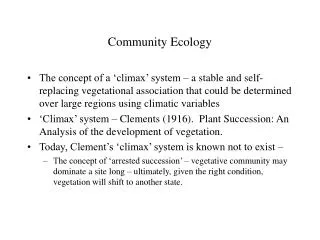
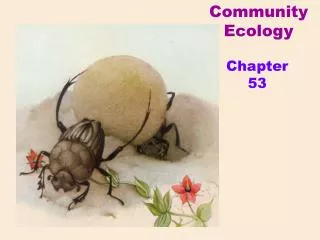
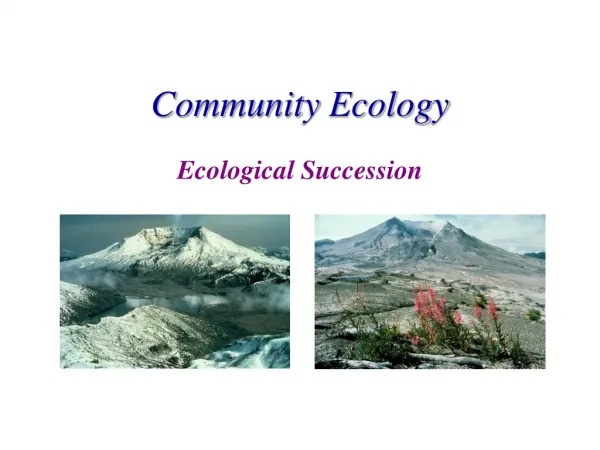
Community Ecology Ecological Succession
Disturbance • An event that changes a community • May include: • Removal of organisms • Alteration of resources available • Examples: • Storm • Fire • Overgrazing • Human activity
Intermediate Disturbance Hypothesis • Moderate levels of disturbance creates greater opportunities/conditions for species diversity • opens up habitats for less competitive species • Doesn’t damage the environment beyond recovery
Ex. Yellowstone National Park Fires • Fires allowed new species to grow and a new generation of Lodgepole pines to grow
Ecological Succession • Progressive sequence of changes in the species that make up a community Image taken without permission from http://bcs.whfreeman.com/thelifewire/default.asp?s=&n=&i=&v=&o=&ns=0&uid=0&rau=0
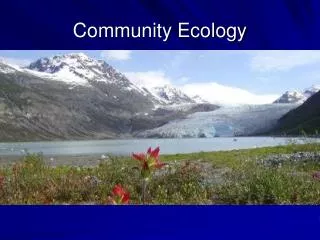
Primary Succession • Process begins in a lifeless area where soil has not yet formed • Ex. Glacier retreating reveals volcanic rock • Lichens & mosses grasses & shrubs trees
Secondary Succession • Existing area has been cleared by some disturbance– but the soil is still intact • Ex. Yellowstone fires, cornfield abandoned
Image taken without permission from http://www.sbs.utexas.edu/levin/bio213/ecosystems/ecology.html