Proteins & Nucleic Acids
This guide provides a comprehensive overview of proteins and nucleic acids, focusing on their structures, functions, and significance in biological systems. It explains the roles of proteins as enzymes, hormones, and structural components, as well as the formation of polypeptides through peptide bonds. Furthermore, it discusses the four levels of protein structure: primary, secondary, tertiary, and quaternary, and highlights the crucial concept of protein folding and denaturation. Additionally, it covers nucleic acids, detailing their function in genetic information storage and the components of nucleotides.

Proteins & Nucleic Acids
E N D
Presentation Transcript
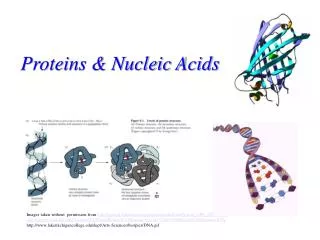
Proteins & Nucleic Acids Images taken without permission from http://upload.wikimedia.org/wikipedia/de/4/4d/Protein_GFP_1EMA.png, http://cmgm.stanford.edu/biochem201/Slides/Protein%20Structure/Levels%20of%20Protein%20Structure.JPG, http://www.lakemichigancollege.edu/dept/Arts-Sciences/bio/pics/DNA.gif
Proteins: A General Overview • Biological roles: enzymes, structural components, hormones, immune function, storage, transport, muscle contraction • Monomer = amino acid • Polymer = polypeptide chain (protein)
R group Carboxyl group Amino group Central carbon hydrogen Monomer = amino acid • There are 4 components attached to a central carbon • There are 20 different amino acids • the R group for each amino acid is different determines its properties
Classes/Categories of Amino Acids • The R group determines the class/category of an amino acid • General categories: • Nonpolar • Polar • Positively Charged • Negatively Charged
Peptide bond Peptide Bonds • Formation of a protein occurs when amino acids covalently bond through the formation of a peptide bond. • What kind of reaction forms a peptide bond? • Dehydration reaction
All proteins have primary, secondary and tertiary structure Four Levels of Protein Structure • Primary • Secondary • Tertiary • Quaternary • Only proteins with multiple chains will have this level of structure
Primary Sequence of Hemoglobin Chain A: VLSPADKTNVKAAWGKVGAH......etc N terminus C terminus Primary Structure (1°) • The sequence of amino acids • All other structures are based on this level of structure
Secondary Structure (2°) • Local helical coiling (alpha helix) or pleated sheet (beta sheet) formations in the chain • Patterned formations based on hydrogen bonds between non-adjacent amino acids
Tertiary Structure (3°) • The way the polypeptide chain is folded three dimensionally. • Is brought about through the following interactions: • Disulfide bridges • Ionic interactions • Hydrophobic interactions • Hydrogen bonds
Quaternary Structure (4°) • Interaction between two or more polypeptide chains.
Important Protein Concept • Changes in protein structure can lead to disease • Ex. Sickle cell anemia = disease caused by a single amino acid substitution in the b chain of hemoglobin Image taken without permission from http://www.sciencecollege.co.uk/SC/natural_selection/sickle_cell.jpg
Protein Folding Denaturation = unfolding of protein • Proteins are folded into the appropriate formation during or after protein synthesis • Certain conditions such as temperature, pH, and salt concentrations can alter the shape of a protein • Chaperonins assist to fold proteins correctly in the cell • Think “chaperones”
Nucleic Acids • Biological roles = Store/carry genetic information, form part of ribosomes, energy carriers • Monomer = Nucleotide (A, T, C, G) • Polymer = Nucleic Acid • DNA • RNA
Nucleotide Components • Consist of 3 parts: • Phosphate group • 5 carbon (pentose) sugar • Nitrogenous base • A, T, C, G, U (RNA only)