Adverbs
This overview explains adverbs as words that modify verbs, adjectives, and other adverbs, providing nuances in meaning. It details how they answer questions related to time, place, manner, degree, and cause. The guide includes examples of various adverbs, such as those indicating frequency and manner, along with practical exercises. By mastering adverbs, learners can enhance their language skills and express thoughts more precisely. Explore commonly used adverbs and deepen your understanding of their function in sentences.

Adverbs
E N D
Presentation Transcript
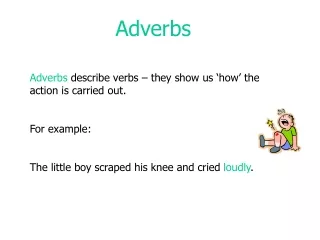
Adverb: • A word used to modify (describe) or limit (make specific) the meaning of a verb, an adjective, or another adverb. Most adverbs are formed by adding mente to adjectives • An adverb that modifies a verb answers any of four questions: • Where? When? In what manner? To what extent?
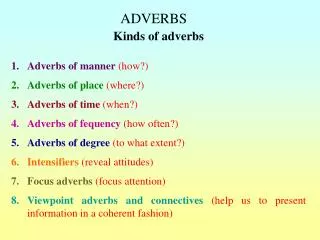
In summary: • Adverbs tell manner (how), time (when), place (where), degree (how much), and sometimes cause (why).
ADVÉRBIOS of timeof placehow you feel Quando? Onde? Como? hoje em cima de bem amanhã debaixo de mal sempre em frente de nunca atrás de depois de entre /do/da (after)
OUTROS ADVÉRBIOS • naturalmente / rapidamente, depressa / devagar, lentamente (slowly) / freqüentemente raramente / geralmente / regularmente / realmente / tipicamente/ claramente / corretamente / tradicionalmente / normalmente / simplesmente / perfeitamente / corretamente / relativamente / logicamente * atualmente = at the present time
Completar: 1. Ele caminha ____________ (slowly) 2. Às vezes, a professora fala português___________ (fast) 3. Os estudantes vão a festas ______________ (frequently) 4. Eu como hambúrgueres e batatinhas fritas ___________ (rarely) 5. ____________ , a professora devolve (returns) os exames no dia seguinte. (generally) 6. A Susana vai ao ginásio ______________ (regularly) 7. ______________, comemoramos o Dia das Mães no segundo domingo de maio. (Traditionally)
8. O hambúrguer e o cachorro (dog) quente são comidas ______________ americanas. (typically) 9. ______________, eu chego ao campus às 9:15. (Normally) 10. A mãe ______________ serve macarrão com queijo. (simply) 11. Você sabe (know)_____________ ________ que eu não tenho muito dinheiro. (perfectly well) 12. O João é de Portugal. _____________ ele fala bem o português. (logically) 13. É importante pronunciar as palavras ______________ (corrrectly) 14. ___________ os médicos não escrevem _____________ (generally / clearly)