
Differences Between Universalizing and Ethnic Religions: Holy Places and Calendars
This text explores the distinctions between universalizing and ethnic religions, focusing on their holy places and calendars. Universalizing religions, like Buddhism and Islam, are typically linked to significant events in the founders' lives and are concentrated in urban areas. In contrast, ethnic religions are often tied to specific physical features of the land and have a more localized distribution. Both types of religions value pilgrimage, highlighting their importance in spiritual practices. Examples include key Buddhist sites in Northeast India and significant Islamic locations like Makkah and Medina.

Differences Between Universalizing and Ethnic Religions: Holy Places and Calendars
E N D
Presentation Transcript
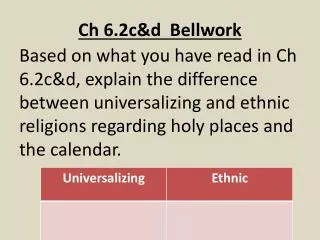
Ch 6.2c&d Bellwork Based on what you have read in Ch 6.2c&d, explain the difference between universalizing and ethnic religions regarding holy places and the calendar.
6.2 Why Do Religions have Different Distributions? C. Holy Places • Universalizing– mostly in cities, tied to founder’s life, not usually tied to physical features of land • Ethnic – less widespread, usually tied to distinctive physical features of land • BOTH – making a pilgrimage (religious journey) is important
6.2 Why Do Religions have Different Distributions? C. Holy Places in Universalizing Religions Buddhism & Islam • Emphasis on important events in the founders’ lives – become shrines (holy places) • Buddhism – 8 places of important events in the Buddha’s life all in NE India & S Nepal (birthplace, reached enlightenment, 1st sermon, reached Nirvana (death), miracles…) • Islam – cities associated with founder’s life (Makkah-birth place, Medina-first followers from, Jerusalem-vision & went to Heaven)
6.2 Why Do Religions have Different Distributions? C. Holy Places in Universalizing Religions Sikhism • Golden Temple in Punjab: base for launching attacks in support of Sikhism, 1000 Sikhs were slaughtered by Indian army, Gandhi was assassinated by a Sikh body guard