Advancements in Wireless Sensor Networks: Introducing Freemote
150 likes | 270 Vues
The Freemote workshop, held in Lappeenranta, Finland, on August 21, 2008, showcased innovations in wireless sensor networks (WSNs) and the Freemote architecture. The session covered Freemote's capabilities in mixing real and emulated nodes, its configuration flexibility, and integration with emerging Java motes and TinyOS. Key topics included future improvements, validation of signal propagation models, and realistic energy measurements. Participants learned about deploying applications efficiently on both emulated and actual devices within the ZigBee framework.


Advancements in Wireless Sensor Networks: Introducing Freemote
E N D
Presentation Transcript
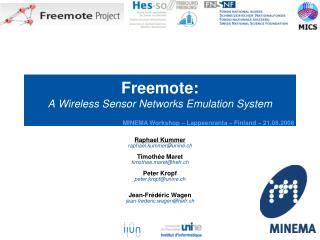
Freemote:A Wireless Sensor Networks Emulation System MINEMA Workshop – Lappeenranta – Finland – 21.08.2008 Raphael Kummerraphael.kummer@unine.ch Timothée Marettimothee.maret@hefr.ch Peter Kropfpeter.kropf@unine.ch Jean-Frédéric Wagenjean-frederic.wagen@hefr.ch
Agenda • Context • Freemote architecture • How to work with Freemote • Future improvements • Conclusion
Wireless Sensor Networks • Highly specialized operating systems adapted to limited hardware resource • TinyOs • Contiki • … • Complex, hard to learn programming languages • NesC • Application specific virtual machine • Maté • SwissQM • Freemote: • Lightweight Java-based tool for Java-based motes • Focus on behavior credibility • Mix real and emulated nodes • Fully configurable • Compatible with standards
Future development • Integrate emerging Java Motes like Sentilla Point • Integrate TinyOS 2 • Linking Freemote with TOSSIM • Running experiments including Java and TinyOS nodes (TinyOS 1 & 2) • Link topology manager with InCov (Echenard and Wagen 2006) • Reproduce IEEE 802.15 signal propagation in indoor environments • Emulate more realistically WSNs • Experiment network • Introduce realistic energy consumption measurements • Introduce CPU measurements • Provide live configuration and statistical tools
Preliminary experiment • « ping » request using TinyOS 1 (AODV ad-hoc routing)
InCov : Coverage prediction for realistic radio simulation ISM ZigBee 2.4GHz band InCov prediction could replace the unrealistic circular coverage usually used in simulations [ http://home.hefr.ch/wagen/InCov/ ]
Validation InCov RSSI Up RSSI Down RSSI Down RSSI Up Both Received Signal Strengh Indicator RSSI estimated on the up- and down-link (or no coverage) are measured and compared to InCov prediction (shown previously).
Conclusion • 10’000 nodes emulation system • Java Mote emulation system • Same code runs on emulated nodes and JMotes (EIA-FR) • ZigBee compatible (e.g., Berkeley motes) • GUI • Available at: http://www.assembla.com/wiki/show/freemote/ • Free code source • Run directly from website (Java Web Start) • Basic system • Many possible improvements (TinyOS 1 not supported anymore => TYMO routing, Java on Sentilla motes, InCov validation in various building, … ) • Open to propositions: contact authors
Thanks to Fabien Le Saoût & Pierre Plaçais for their work during their 3 months stay at EIA-FR Thank you! MINEMA Workshop – Lappeenranta – Finland – 21.08.2008 http://www.assembla.com/wiki/show/freemote