
Minerals
E N D
Presentation Transcript
Minerals Unit 3 Notes
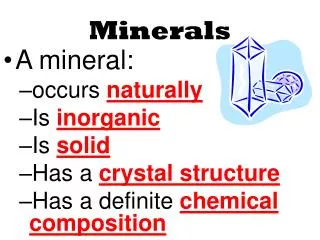
What is a mineral? • A mineral must be all of the following: • Naturally occurring • Inorganic solid (not living) • Definite structure • Definite composition (what it’s made of)
What is a crystal? • A crystal is a solid in which the atoms are arranged in repeating patterns
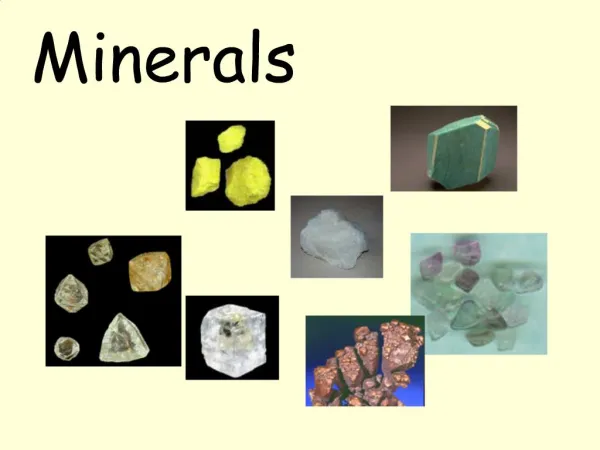
Crystal Structure • Here are the six crystal systems that all minerals belong to: • Cubic – sylvite, halite • Hexagonal – emerald, graphite • Tetragonal – wulfenite, zircon • Orthorhombic – topaz, sulfur • Monoclinic – gypsum, mica • Triclinic – kyanite, turquoise
Mineral Composition • Silicates (Si & O) • Carbonates (C & O)
Silicates The silica tetrahedron consists of four oxygen atoms packed closely around a single silicon atom. Named for its shape (like a 3D pyramid).
How do minerals form? • 3 Ways: • Cooling of molten rock (lava or magma) • Evaporation of liquid • Saturated solutions
Mineral Crystal Size • Small Crystals – indicates slow cooling of molten rock • Large Crystals – indicates fast cooling of molten rock
Mineral Identification • Color – color is the first property you notice – this is usually the 1st step in identification, but the least useful
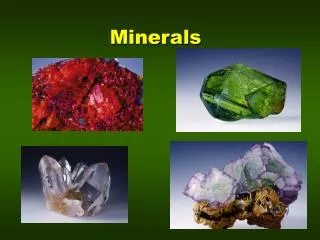
Quartz and Fluorite come in many different colors
Mineral Identification • Hardness – is a mineral’s resistance to being scratched
Moh’s Scale of Hardness • Scale ranges from 1 to 10 • 1 is softest & 10 is hardest
Factoid • What is the hardest substance on Earth?? • A diamond is the hardest substance (10 on Moh’s scale)
Mineral Identification • Streak – the color of the powder left when a mineral is rubbed against a hard rough surface (usually unglazed porcelain)
Mineral Identification • Luster – the way light reflects from a minerals surface
2 Types of Luster • Metallic – shiny • Nonmetallic – glassy, brilliant, greasy, oily, waxy, silky, or pearly
Metallic Luster Pearly Luster (Non-Metallic) Vitreous Luster (Non-Metallic)
Mineral Identification • Cleavage – mineral breaks along smooth surface • Fracture – mineral breaks unevenly (jagged)
Mineral Identification • Specific Gravity – comparing density of a mineral to the density of water
Mineral Identification • Acid Test – some minerals give off CO2 (carbon dioxide) when acid is added.
Mineral Usage • Ore – mineral resource mined for a profit • Gem – mineral that is beautiful, rare, and valuable
Metals • Metals are elements that have metallic luster, malleability, ductility, and conductivity
Malleability • the ability of a mineral to be hammered without breaking
Ductility • the ability to be pulled and stretched without breaking
Conductivity • the ability to conduct heat or electricity