Ions in Aqueous Solutions and Colligative Properties
380 likes | 519 Vues
Ions in Aqueous Solutions and Colligative Properties. Chapter 14. Dissociation. The separation of ions that occurs when an ionic compound dissolves. Dissociation examples. You try.


Ions in Aqueous Solutions and Colligative Properties
E N D
Presentation Transcript
Ions in Aqueous Solutions and Colligative Properties Chapter 14
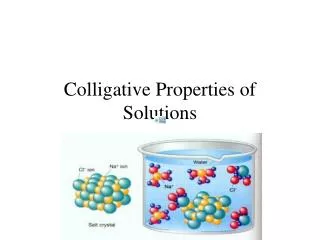
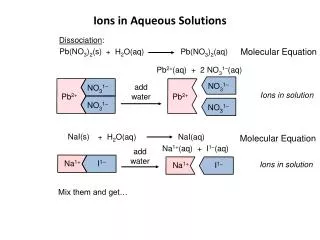
Dissociation • The separation of ions that occurs when an ionic compound dissolves.
You try • Write the equation for the dissolution of NH4NO3 in water. If 1 mol of ammonium nitrate is dissolved, how many moles of each type of ion are produced? • 1 mol of each type of ion
Precipitation Reactions • When two solutions are mixed, a double replacement reaction may occur. • If one of the products is insoluble, it will form a precipitate. • See table 14-1 on page 427
Example • Solutions of (NH4)2S and Cd(NO3)2 are mixed. Will a precipitate form?
Example continued The cadmium sulfide is the precipitate.
Net Ionic Equations • Includes only those compounds and ions that undergo a chemical change in a reaction in an aqueous solution.
Spectator Ions • Ions that do not take part in a chemical reaction and are found in solution both before and after the reaction.
You try • A solution of sodium sulfide is combined with a solution of iron(II) nitrate. Does a precipitate form? • Iron(II) sulfide is the precipitate.
You try continued • Write the net ionic equation for the previous reaction.
Ionization • The process that forms ions from solute molecules by the action of the solvent. • The attraction between the solvent and the solute is strong enough to break the covalent bonds.
Hydronium • H3O+ • Formed when an H+ ion is combined with a water molecule (hydrated). • Happens instantly when H+ ions are in water. • Highly exothermic • Formed by many molecular compounds that ionize
Strong electrolytes • Any compound whose dilute aqueous solutions conduct electricity well. • All or almost all dissolved compound is in the form of ions • Not all compound has to dissolve, but the part that does must be ions
Weak electrolytes • Any compound whose dilute aqueous solutions conduct electricity poorly. • A small amount of the dissolved compound is in the form of ions.
Be careful! • Strong electrolytes have a high degree of ionization or dissociation, regardless of their concentration. • Weak electrolytes have a low degree of ionization or dissociation, regardless of their concentration.
Colligative Properties • Properties of solutions that depend on the concentration of solute particles, but not the identity of solute particles.
Nonvolatile substance • Has little tendency to become a gas under existing conditions.
Vapor-pressure lowering • The vapor pressure of a solvent containing a nonvolatile solute is lower than the vapor pressure of the pure solvent at the same temperature. • The solute lowers the concentration of solvent molecules at the surface. • Fewer molecules enter the vapor phase.
Effects • See figure 14-6 on page 436 • The solution remains liquid over a wider temperature range. • The freezing point is lowered and the boiling point is raised.
Molal freezing-point constant • Kf • The freezing point depression of the solvent in a 1-molal solution of a nonvolatile, nonelectrolyte solute. • = -1.86 °C/m for water • 2 molal decreases 3.72 °C
Freezing-point depression • The difference between the freezing points of the pure solvent and a solution of a nonelectrolyte in that solvent. • It is directly proportional to the molal concentration of the solution.
Example • Determine the freezing point of a water solution of fructose, C6H12O6 made by dissolving 58.0 g of fructose in 185 g of water. • -3.24 °C
You try • Determine the molal concentration of a solution of ethylene glycol, HOCH2CH2OH, if the solution’s freezing point is -6.40 °C. • 3.44 m
Molal boiling-point constant • The boiling-point elevation of the solvent in a 1-molal solution of a nonvolatile, nonelectrolyte solute. • Kb = 0.51 °C/m for water
Boiling-point elevation • The difference between the boiling points of the pure solvent and a nonelectrolyte solution of that solvent. • Directly proportional to the molal concentration of the solution
Example • What is the boiling point of a solution of 25.0 g of 2-butoxyethanol, HOCH2CH2OC4H9, in 68.7 g of ether? • 40.8 °C
You try • What mass of glycerol, CH2OHCHOHCH2OH, must be dissolved in 1.00 kg of water in order to have a boiling point of 104.5 °C? • 810 g
Semipermeable membrane • Allows the movement of some particles while blocking the movement of others. • Example: allows water molecules through, but not sucrose molecules
Osmosis • The movement of solvent through a semipermeable membrane from the side of lower solute concentration to the side of higher solute concentration.
Osmotic pressure • The external pressure that must be applied to stop osmosis. • The greater the concentration of a solution, the greater the osmotic pressure.
Electrolytes • 1 mole of an electrolyte produces more than one mole of particles in solution. • The ions separate
Example • A water solution contains 42.9 g of calcium nitrate dissolved in 500. g of water. Calculate the freezing point of the solution. • -2.92 °C
You try • What is the expected boiling point of a 1.70 m solution of sodium sulfate in water? • 102.6 °C
Actual values • Our expected values are not always what is observed. • See table 14-3 on page 445 • Differences are caused by attractive forces between ions in solution.