
SlideServe
Menu
Préférences
© SlideServe · v2026

Understanding Atoms and Elements

howie avatar
25 diapositives · 350 Views · Oct 13, 2014

Learn about atoms, the Periodic Table, subatomic particles, and how to identify elements. Explore atomic structure and valence electrons.
Understanding Atoms and Elements - slide 1
01 / 25Understanding Atoms and Elements
1 / 17

Télécharger la présentation

Understanding Atoms and Elements
Une image / un lien ci-dessous est fourni (tel quel) pour télécharger la présentation

Politique de téléchargement : le contenu du site vous est fourni TEL QUEL pour votre information et votre usage personnel ; il ne peut être vendu, concédé sous licence ni partagé sur d’autres sites sans l’accord de son auteur.Le contenu vous est fourni TEL QUEL, pour votre information et votre usage personnel uniquement. Téléchargez la présentation en cliquant sur ce lien. Lors du téléchargement, si vous ne parvenez pas à télécharger une présentation, l’éditeur a peut-être supprimé le fichier de son serveur.Pendant le téléchargement, si vous ne parvenez pas à obtenir une présentation, le fichier a peut-être été supprimé par l’éditeur.

F I N

Plus de contenu associé

Transcription de la présentation
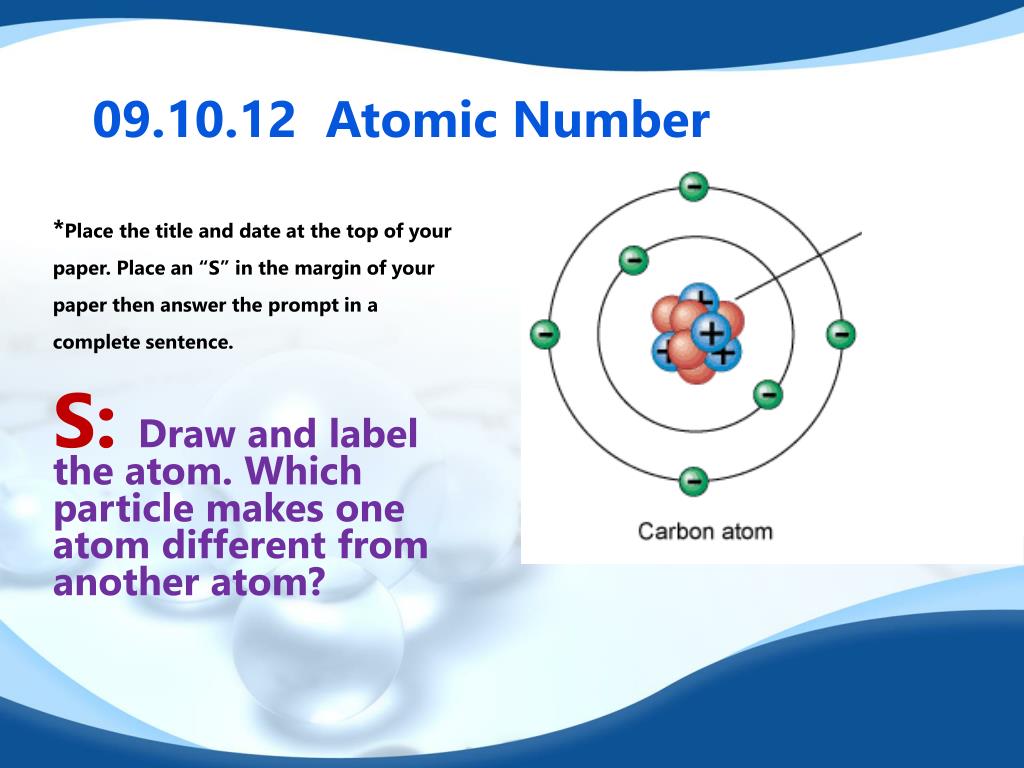
  1. 09.10.12 Atomic Number *Place the title and date at the top of your paper. Place an “S” in the margin of your paper then answer the prompt in a complete sentence. S: Draw and label the atom. Which particle makes one atom different from another atom?

  2. P: What the Periodic Table Tells You Copy & Label: A. Atomic Number B. Atomic Mass C. Chemical Symbol D. Element Name

  3. P: What the Atomic Number Tells You • The Atomic Number: • Equals the number of protons in the nucleus • Can also help you determine the number of electrons in an atom • Is easily found on • the Periodic Table

  4. A: Drawing Atoms If you do not finish its for homework.

  5. C: What Identifies You as You? List 5 things that can be used to identify you. For example: hair color and height.

  6. E: Johnny has a test on Atoms this week. He is still having some trouble understanding the parts of an atom. Explain the role, location, and charge of each subatomic particle in an atom to Johnny so he can pass his test!

  7. 09.11.12 Atomic Mass *Place the title and date at the top of your paper. Place an “S” in the margin of your paper then answer the prompt in a complete sentence. S: Copy the image and label each line. What does the Atomic Number tell you about an atom? Chemical Symbol Element Name

  8. P: Atomic Mass? Say What? • The Atomic Mass: • Equals the number • of protons + number • of neutrons in the • nucleus • Unit = AMU • (atomic mass unit) • The exact Atomic • Mass is found on • the Periodic Table Atomic Mass = # of Protons + # of Neutrons

  9. Proton P: Neutron electron

  10. A: CH 2 Section Review: Finish: -Read Section 2 pg 44-49. Then complete the Section Review on page 49 1-4.

  11. C: Identifying Elements Choose your favorite element from the Periodic Table. Write down its element name, chemical symbol, atomic number, atomic mass, # of protons, and # of electrons.

  12. E: Determine which element each image is depicting. 1. 2.

  13. 9.12.12 Valence Electrons S: What is a valence electron? How do they relate to an atom’s reactivity?

  14. P: Intro To Valence Electrons / Electron cloud. Carbon Atom The electron cloud is the group of electrons revolving around the nucleus of an atom; a cloudlike group of electrons The valence electrons are found in the outermost energy level of an atom. Valence electrons of an atom are responsible for chemical reactions. 1st energy level 2nd energy level (outermost) Carbon atom has 4 valence electrons.

  15. P: Compare reactive elements and stable elements. Carbon Atom Oxygen Atom Neon Atom 1. Atoms are more likely to be reactive if they have between 1 and 7 valence electrons. 2. An atom that has 8 valence electrons is considered stable and non-reactive because the outermost energy level is completely filled and cannot bond with other atoms. 3.The number of valence electrons determines the number of reactions an atom can make. 4. Oxygen has 6 valence electrons. Carbon has 4 valence electrons. Which atom can react or make more Bonds? Ans. Oxygen because it can bond/react 6 times compared to carbon that can only Make 4 bonds/react at a time.

  16. A: Identify these atoms:

  17. C: What Questions do you still have before the test on Friday?

  18. E: Compare Elements Determine which element is more stable. Explain why? OXYGEN ATOM NEON ATOM

  19. 9.13.12 Atom Jeopardy Review S:What can the number of protons tell you about an atom?

  20. P, A, & C: Jeopardy Review

  21. E: Questions and Answers What areas do we need to go over to be successful on tomorrows test?