Download
1 / 8
90 likes | 214 Vues
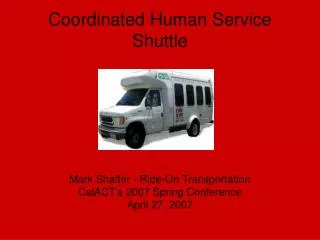
The Coordinated Transportation Service Model aims to streamline transportation services by sharing resources among partners to increase ridership and minimize expenses. Targeting a population of 70,000, this model utilizes a fleet of 12 ADA vehicles and serves fixed routes, ADA paratransit, and the 85.21 Elderly and Disabled Program, combining 50,000 trips annually. A centralized dispatch and call center enhance service efficiency, maximizing funding opportunities and reducing service duplication. Coordination not only improves service delivery but also boosts local funding to expand operational budgets effectively.

E N D
What is Coordinated Services? • Common Goals • Increase ridership • Minimize expenses • Maximize Revenues • Build Partnerships • Share Resources • Reduce duplication of services • Maximize impact
On Board with Sheboygan! • Fixed Route and Specialized Transportation Services • ADA Paratransit and 85.21 Elderly and Disabled Program • Service a population of 70,000 individuals • Fleet of 12 ADA vehicles (shared Capital investments) • Coordinated Service Model • County and City “coordinate” transportation together! • Provided by Metro Connection • Combined 50,000 trips annually
What does coordination mean? • Enhanced network of transportation • Fixed Route, ADA Paratransit & 85.21 Program • Availability to maximize Federal and State funding • 85.21 Program funds contribute to local share • One dispatch center for all specialized trips • One call center for all specialized trips • Leverage more dollars for operations • Cross-certification of passengers (most appropriate program)
How does Funding Work? • Local share: 45% of Expenses • Increases in local share allow for increases in Federal and State portions (assuming funding availability). • Decreases in local share consequently decreases the Federal and State portions. • Federal/State share: 55% of Recognized Expenses • Sheboygan Example: • $920,000 in local share contribution allows for an operating budget of $4,000,000! • Decrease to $600,000 would yield approximate $2,850,000 • Loss of both expenses and revenues!
Coordination Benefits • 85.21 Program • $450,000 in service for $320,000 • Larger service area, longer hours and inexpensive fares • Convenience of cross-certified passengers to use one provider! • Additional County staff likely funded out of program (further reducing $ spent on actual trips)
Coordination Benefits • Metro Connection/Shoreline Metro • 85.21 Program dollars used as part of local share (leverage more state and federal dollars) that fund entire operational budget • Transportation experts! • All revenues offset transportation expenses! • Passengers have one number for transportation!