Understanding Probability and Heredity in Genetics
This resource explores the relationship between probability and heredity, focusing on how plant and animal cells contain numerous genes with varying forms, or alleles. Students will learn about dominant and recessive traits, as well as the application of Punnett squares to predict allele combinations. Key concepts include understanding genotypes (homozygous and heterozygous) and phenotypes, along with the principles of probability that govern genetic crosses. This insightful guide provides a foundational understanding of genetic inheritance and expression.

Understanding Probability and Heredity in Genetics
E N D
Presentation Transcript
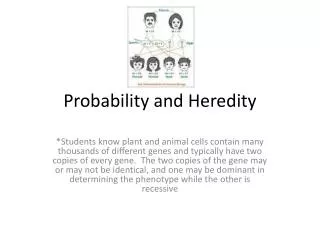
Probability and Heredity *Students know plant and animal cells contain many thousands of different genes and typically have two copies of every gene. The two copies of the gene may or may not be identical, and one may be dominant in determining the phenotype while the other is recessive
Principals of Probability • Probability • Is a number that describes how likely it is that a certain event will occur
Probability and Genetics Punnett Square Genetic Cross Is a chart that shows all the possible combinations of alleles that can result from a genetic cross The allele that each parent will pass on is based on probability
Predicting Probabilities • The possibility of TT is ¼ or 25% • The possibility of Tt is 2/4 or 50 % • The possibility of tt is ¼ or 25% • http://www.athro.com/evo/gen/punexam.html
Phenotypes and Genotypes • Phenotype • genotype • Physical appearance or Visible traits • Genetic makeup or allele combination
Genotypes • Homozygous • heterozygous • An organism has two identical alleles for a trait. - TT or tt • An organism has two different alleles for a trait.- Tt
Codominance • Codominance • The alleles are neither dominant nor recessive. As a result both alleles are expressed in the offspring