The Atmosphere - global warming L2
340 likes | 483 Vues
This comprehensive overview of Earth's atmosphere details its dynamic structure, including layers such as the troposphere, stratosphere, and mesosphere. It highlights crucial components like the ozone layer, its protective function against UV radiation, and the effects of human activities on ozone depletion. Additionally, it examines the hydrological cycle, energy exchanges, and climate change indicators, emphasizing the roles of solar radiation and atmospheric composition. Understanding these interactions is key to addressing global warming challenges for future generations.


The Atmosphere - global warming L2
E N D
Presentation Transcript
The Atmosphere - global warming L2 English in Natural Science 自然科学の英語 自然科学の英語-ENS-L2
Atmosphere 自然科学の英語-ENS-L2
90 km Mesosphere Heterosphere 48 km Stratosphere Ozone layer 12 km Homosphere Troposphere Vertical structure • Density decreases with altitude • gravitational force • Layers of different composition • Homosphere (90 km) • Heterosphere Mass < 1% 14% 85% 自然科学の英語-ENS-L2
Ozone layer • Filter (15-40 km) against UV solar radiation 90% ozone [O3] 2-8 ppm • Destruction by CFC: CFCl3 + hvCFCl3 + Cl O3 + Cl O2 + ClO Effects 1. Increased UV radiation DNA damage (mutations, cancer) 2. Less absorption of radiation Air cooling 自然科学の英語-ENS-L2
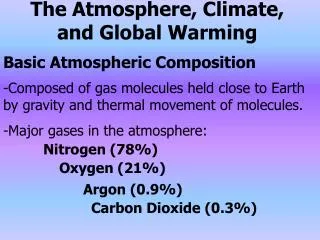
Troposphere • Current composition • N2 (78.08%) • O2 (20.95%) • Ar (0.93%) • CO2 (0.035%) • Other (0.005%) • Ne, He, CH4, Kr, NO2-, H, Xe, O3 • Temperature decreases with altitude • average 1 oC for 100 m surface ~15 oC 1,500 m water condensates • Clouds form between 1500-3000 m 自然科学の英語-ENS-L2
78% N2 21% O2 <1% CO2 95% N2 3.5% CO2 <1% O2 Evolution of atmosphere 自然科学の英語-ENS-L2
Atmosphere is dynamic • Solar powered • Convection • Hot air UP • Cold air DOWN • Circulation routes • west east • tropics poles • Jet streams • Effects: • Mixing of gasses • Temperature buffer 自然科学の英語-ENS-L2
C Tropical cyclon 台風typhoon hurricane Coriolis effect • Rotation of the Earth • Air moves inward in circles cyclons • Inertial circles Centrifugal force 自然科学の英語-ENS-L2
Hydrological cycle Energy Sun Water on Earth • Oceans (97%) • Salty water • Atmosphere • Evaporation (H2O vapour) • Condensation(cloud) • Precipitation (rain) • Land • Snow icecaps water • Runoff rivers • Dissolves materials • Erosion of land • Evapotranspiration (plants) Evapotranspiration 自然科学の英語-ENS-L2
The Blue Planet 自然科学の英語-ENS-L2
Hydrosphere - water distribution 自然科学の英語-ENS-L2
Interaction atmosphere - hydrosphere • Solar radiation • Water evaporation (oceans) condensation (clouds) • Hot air UP and cold air DOWN • Earth’s rotation • Air + clouds move in inertial circles (cyclons) • Earth’s topography (e.g. mountains) • Distort movement of cyclons • Cause precipitation (rain) • Region different weather pattern CLIMATE 自然科学の英語-ENS-L2
Climate patterns Koeppen System 1st level: latitude zone • Tropical • Subtropical • Temperate • Polar • Mountain/highland 2nd level: precipitation • Regular throughout year • Dry winter • Dry summer 3rd level: temperature • Hot • Mild • Cool • Cold 自然科学の英語-ENS-L2
Cs: Mediterranean (dry summer subtropical) • Cfa: Humid Subtropical • CFb: Marine West Coast • Df & Dw: Humid Continental & Subarctic • ET: Tundra • Highland • Af: Tropical Rainforest • Aw: Tropical Wet & Dry (Savanna) • BSh: Tropical Steppe • BWh: Tropical Desert • BSk&BWk: Midlatitude Steppe & Desert 自然科学の英語-ENS-L2
Climate change: Causes • Weather changes - short term cycles • Sun spots fluctuations (11 yr period) • Sea-temperature currents (El Niño oscillations) • Climate changes - long-term oscillations • Solar radiation (insolation) • Precession of equinoxes (23,000 yr period) • Tilt (1o) of Earth’s rotational axis (41,000 yr period) • Eccentricity cycle (100,000 and 400,000 yr period) Milankovitch cycles • Carbon dioxide and methane in atmosphere • Biomass amount and distribution 自然科学の英語-ENS-L2
Climate indicators • 18O ice-sheet thickness sea level • 13C biomass (productivity) • CO2 atmospheric temperature carbonate deposition/dissolution • CH4wetland expansion/reduction monsoonal precipitation 自然科学の英語-ENS-L2
Temperature cycles 11 x 2 yr period • Southern • Oscillation Index • (El Niño) • cold dryness • warm rainfall Humdbolt Current Weather cycles 自然科学の英語-ENS-L2
Axial tilt Polaris<-->Vega Orbit eccentricity Precession Astronomic variations insolation 自然科学の英語-ENS-L2
Holocene (10,000 yr) • Insolation • perihelion from July to January • 8% more insolation summer and less in winter NH • Effects • Global ice-volume decreased (18O from 15,000 to 6,000 yr) • Sea-surface temperature up (8 oC Atlantic winter) • Sea level up (100 m) • CO2 increased • 200 ppm (15,000 yr) 250 ppm (6,000 yr) 自然科学の英語-ENS-L2
Pleistocene (175,000 yr) • Insolation • superimposition 23, 41 and 100 year cycles • Effects • Ice-sheet (18O) • Sea-level • CO2 • methane • Monsoon (SE Asia) 自然科学の英語-ENS-L2
Quaternary (3 million yr) • Directly related to insolation cycles • Patterns of variation • Several ice-age periods • Cooling trend in last 700,000 yr • Changes in biomass (productivity) • Irreversible variations due to continental drift • Mountain uplift regulate the magnitude of monsoonal oscillations 自然科学の英語-ENS-L2
(Webb and Bartlein, 1992) 自然科学の英語-ENS-L2
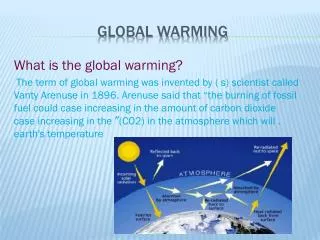
CO2 CH4 +150% +36% NO2 +20% Greenhouse gasses • Transparent to incoming solar radiation • Absorb outgoing infrared radiation (l > 0.78 mm) emitted by Earth (surface + atmosphere) Radiative forcing W/m2 relative CO2 1.56 1 CH4 0.5 58 NO2 0.1 206 CFC 0.3 3970 5750 CFC 自然科学の英語-ENS-L2
Carbon dioxide (CO2) and temperature • Antarctica • Vostok lake(160,000 yr) What causes CO2 cycles? (Barnola et al., 1987) 自然科学の英語-ENS-L2
Atmospheric CO2 Initially (3.5 bya) 100 x Reduction… Biomass Carbonate deposition Now 300 Gt (x109 tons) Upward trend Sources 98% natural Biological Volcanic eruptions 2% human activities Keeling curve Current CO2 in atmosphere Before 1800 190-290 ppm 1800 280 ppm 2004 380 ppm Total increase +36% Current rate 1.8 ppm/yr 自然科学の英語-ENS-L2
Human impact on the carbon cycle Sources of CO2 6-8 Gt/year (1995) • Emissions (83%) • Fossil fuels (CO2, CH4) 6.5 Gt • Fertilizers (NO2) 0.140 Gt • Deforestation (17%) 0.4 m Km2/year 36,000 Km2 Amazon 自然科学の英語-ENS-L2
44% 36% 20% Carbon balance 自然科学の英語-ENS-L2
Effects: global warming • Average air temperature increased I) 0.7 oC in 30 yr ii) 2003 heat wave in Europe 94 mt harvest lost (5% world grain) 自然科学の英語-ENS-L2
Effects in theocean… …start to be felt. • Sea levels in Gulf of Mexico • Wild weather • Katrina, Rita • Japan 2004 (11 typhoons) 自然科学の英語-ENS-L2
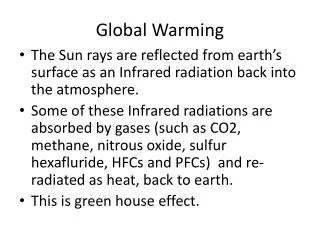
Global climatic impact of CO2 • Global warming[CO2] UP Temperature UP Temperature • Air: more H2O vapour rainfall increase pressure wild weather (typhoon) • Water: melting icecaps increase sea levels [CO2] • Air: photosynthesis UP more plant biomass • Water: dissolved CO3-2 coral and marine plankton • Ice-age[CO2] DOWN Temperature DOWN • Air: less H2O vapour rainfall decrease dryness dust UP less radiation (cooling) • Water: icecaps increase decrease sea levels 自然科学の英語-ENS-L2
Warm periods Iceage [CO2] [CO2] Temp Temp Vegetation Ice Ice Vegetation [HCO3-] [HCO3-] [CO3-2] [CO3-2] [CO3Ca•Mg] [CO3Ca•Mg] dissolve precipitate Alternating warm/cold cycles 自然科学の英語-ENS-L2
References • Schneider, S. H. 1989. The greenhouse effect: Science and policy. Science 243: 771-81. • Webb III, T. and Bartlein, P.J. 1992. Global changes during the last 3 million years: Climatic controls and biotic responses. Annu. Rev. Ecol. Syst. 23: 141-173 • Wuebbles, D.J. and Jain, A.K. 2001. Concerns about climate change and the role of fossil fuel use. Fuel Proces. Technol. 71: 99-119 • Feely R.A. et al.2004. Impact of anthropogenic CO2 on the CaCO3 system in the oceans. Science 305: 362-366 自然科学の英語-ENS-L2