Understanding Anatomy and Physiology: A Guide for Future RVTs
This introduction to anatomy and physiology highlights the essential components of an animal's body, likening them to a machine's parts. Future Registered Veterinary Technicians (RVTs) must comprehend these components—cells, tissues, organs, and systems—to provide effective care. The chapter discusses the definitions of anatomy and physiology, types of anatomy (microscopic, gross, regional, and systemic), and the main body systems including skeletal, muscular, nervous, and circulatory systems. Understanding anatomical terminology and reference planes is crucial for accurate communication regarding body parts.

Understanding Anatomy and Physiology: A Guide for Future RVTs
E N D
Presentation Transcript
CHAPTER 1 Introduction to Anatomy & Physiology
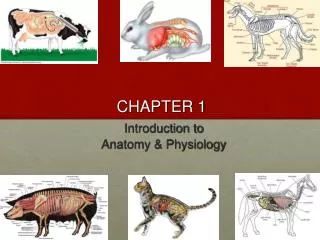
Introduction to Anatomy and Physiology • All parts of an animal’s body are like components to a machine. • These components include: • Cells • Tissues • Organs • Systems • As future RVTs it is your responsibility to understand this machine and how it works, in order to effectively care for it. • We must be able to differentiate “normal” from “abnormal”.
Anatomy and Physiology • ______________: the form and structure of the body and its parts. • What it looks like and where it is located • ______________: the function of the body and its parts. • How things work and what they do
Types of Anatomy • ____________________ anatomy: anatomy of structures so small that a microscope is required to view them clearly. • ____________________ anatomy: anatomy that deals with body parts large enough to be seen with the unaided eye such as organs, muscles and bones. • AKA- gross anatomy • _________________ anatomy: study of individual areas or “regions” of the body. • _________________ anatomy: study of individual systems of the body. • There may be overlap in some of these areas.
Main Body Systems • _______________: bones and joints. • _______________: skin, hair, nails and hooves. • _______________: Central Nervous System (CNS) and peripheral nerves. • _______________: heart and blood vessels. • _______________: lungs and air passageways. • _______________: Gastrointestinal (GI) tube and accessory digestive organs. • _______________: Skeletal, cardiac, and smooth muscle. • _______________: Organs of general and special sense • _______________: Endocrine glands and hormones • _______________: Kidneys, ureters, urinary bladder, and urethra. • _______________: Male and female reproductive structures.
Terminology • We need specific anatomical terminology to be clear and accurate with descriptions of body parts. • Anatomical terms are based on imaginary slices, called ______________ through the animal body that can be used as points or areas of reference. • Anatomical terms are also based on ____________ terms that have opposite meanings of one another.