Fair and Appropriate Grading
250 likes | 378 Vues
This session, led by Dr. Carol Van Zile-Tamsen, focuses on establishing and communicating fair grading policies that positively impact student motivation and performance. Topics include defining grading types, creating clear grading guidelines for assignments and exams, and developing effective documentation to support grading decisions. Attendees will learn how to enhance consistency and transparency in grading while minimizing challenges from students. Emphasizing the importance of teaching what you grade and grading what you teach, this session offers essential insights for educators.


Fair and Appropriate Grading
E N D
Presentation Transcript
Fair and Appropriate Grading Carol Van Zile-Tamsen, Ph.D. Associate Director, Office of Educational Innovation and Assessment Adjunct Instructor, Counseling, School, and Educational Psychology
Session Agenda: Establishing and Communicating Grading Policy Grading Guidelines for Assignments and Exams Grading Documentation Questions
Grading is one of the most important things you'll do as an instructor! Has a permanent impact for the student: Will be on the on the student's transcript forever. Has an immediate impact on student motivation. Grading policies and procedures influence motivation.
Part 1: Establishing and Communicating grading policy
Grades:A Definition A concise, universally understood, summative evaluation of performance. An overall indicator of someone’s performance on an assignment, a test, or in the class as a whole.
Types of Grading: Normative Grading Criterion-Referenced Grading Grades are assigned to students based on how their performance compares to an absolute standard. • Grades are assigned to individual students based on how they compare to other students in the class.
http://www.mathsisfun.com/data/standard-normal-distribution.htmlhttp://www.mathsisfun.com/data/standard-normal-distribution.html Types of Grading:A Visual Representation C B D F A In norm-referenced grading, the score is determined by the distance the student is from the class average. In criterion-referenced grading, the student’s grade is determined by the percentage of content they have mastered.
Grading Policy: Rules for determining a summative grade based on an individual’s performance. Indicates the level of work necessary to earn each grade. The grading policy should be clearly communicated on the syllabus.
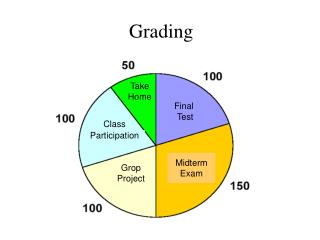
Weighting: • Refers to how grades from distinct requirements will be combined to inform the final grade. • Assignments that take more effort should be given more weight in the final grade than assignments that require less effort. • Participation and the potential for extra credit should also be explicitly addressed.
A Weighting Comparison: Method 1 Method 2
Incomplete Policy: • The syllabus is required to contain the policy for taking an incomplete. • This is available in the undergraduate catalog: • The student must request an incomplete. • The student must have completed enough course work at sufficient quality that it will be possible to earn a higher grade by completing the remainingcoursework.
Final Thought: Teach what you plan to grade, and grade what you teach!
Part 2: Guidelines for grading assignments and exams
Written Work and Open-Ended Assignments: • Clear guidelines should be presented when work is assigned: • Required components; • Weighting of components; and • Criteria for evaluating work. • A grading rubric has many benefits.
Benefits of grading rubrics: • Increase consistency in grading across different students. • Clearly communicates to students what is expected. • Provides more informative feedback to the student. • Makes the grading process more efficient.
Rubrics can also be used for: • Homework problems and/or homework as a whole • Constructed response items on exams • Oral presentations • Performance in group projects • Class participation
Grading Objective Tests and Exams: • Include the content that is most important for students to know. • Make sure that the test is well-designed and that each item has a clearly defensible correct answer. • Include in the instructions the number of points each item is worth. • Make sure the items correspond to material covered in class.
After the test/exam completed: • Complete an item analysis to identify items that may have caused problems for the class as a whole. • Review the results in class, in particular items that caused problems. • It is ok to adjust scores for items that were confusing or not well-written. • Review and/or reteach problematic content.
Part 3: Grading documentation
Grading Challenges: • Sometimes grading decisions are challenged by students. • To help prevent challenges, it is important to: • Establish and communicate a defensible grading policy; • Establish clear criteria for assigning final grades; • Develop guidelines and grading criteria for all requirements; and • Make sure there are clear criteria for participation grades and extra credit.
Grading Documentation: • To prepare for a grading challenge, keep good records: • a copy of the syllabus; • Assignment guidelines and rubrics; • Copies of the quizzes/tests/exams; and • Your completed "grade book" including columns for participation and extra credit if used in grading.
Additional Resources • Books: • Gentile, J. R., & Lalley, J. P. (2006). Educational psychology (3rd edition). Kendall Hunt Publishing. • Suskie, L. (2009). Assessing student learning: A common sense guide (2nd edition). Jossey-Bass. • Walvoord, B., & Anderson, V. J. (2009). Effective grading (2nd edition). Jossey-Bass. • Web Sites: • Academic Policies • http://undergrad-catalog.buffalo.edu/policies/course/index.shtml • http://undergrad-catalog.buffalo.edu/policies/grading/index.shtml • Test Construction • http://prezi.com/rxmzqg6i203x/?utm_campaign=share&utm_medium=copy&rc=ex0share • Using Rubrics • http://prezi.com/rxmzqg6i203x/?utm_campaign=share&utm_medium=copy&rc=ex0share These books and web sites provide additional detail about various aspects of grading and syllabus requirements.
Questions? What other details do you need to know?