Introduction to Engineering Thermodynamics - PE200 Course Outline and Details
This course, Eng. Thermodynamics I (PE200), provides students with a foundational understanding of thermodynamic principles. Topics include the first law of thermodynamics, properties of pure substances, and applications to closed and open systems. By the end of the course, students will be able to define thermodynamics, classify systems, identify energy forms, and apply fundamental laws in engineering contexts. Assessments include quizzes, case studies, and a final exam, ensuring a comprehensive evaluation of student understanding and skills.

Introduction to Engineering Thermodynamics - PE200 Course Outline and Details
E N D
Presentation Transcript
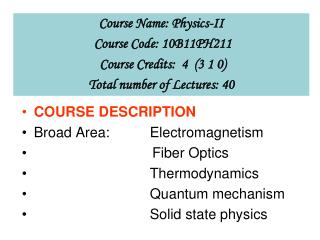
Pharos University in Alexandria Faculty of Engineering. Petrochemical Department Eng.Thermodynamics I (Code: PE200) Prepared by: Dr. EhssanNassef Email :ehssan.nassef@pua.edu.eg
Pre-requisite:Eng.Physics 2: (BE 122) • Lecture: E113. • Tuesday – from 8:30.. to 10:30 A.m • Tut: E122, Wednesday 8:30-10:20 Instructor:Dr.EhssanNassef Email:ehssan.nassef@pua.edu.eg Room: E 128 • Office hours: Sunday from 12:30 to 2:30 • Monday from 12:30 to 2:30 • Thursday: 10:30-12:30 • ………………………………………………………….
Course Aim: At the end of this course the students will be well known of the following: • 1-An introduction to Eng Thermo dynamics. • 2- The first law of thermodynamics on steady flow devices. • 3-The properties of the pure substances. • 4- Closed and open system in engineering thermodynamics. • 5- Apply the first law of thermodynamics on both closed and open thermal engineering systems. • 6-Interactions between heat and work done as both will act as a boundary phenomena affects the total energy of the thermal engineering systems. • 7- Apply the first law of thermodynamics on open flow devices (pumps, diffusers, nozzles,……….). Intended Learning outcomes:
Intended learning outcomes(ILO,S) A- Knowledge and understanding: • a1Define thermodynamics and energy. • a-2 Identify forms of energy. • a-3 Define closed and open system. • a-4 Extensive and intensive properties. • a-5 Identify heat. and work. • a-6 First law of thermodynamics. • a-7 First law of thermodynamics for closed system. • a-8 Define enthalpy and specific heat. • a- 9 First law of thermodynamics for flow process . • a-10 Identify phase and pure substance. • a-11 Thermodynamic state and state functions. • a-12 Gibbs phase rule. • a-13 Ideal gas equation of state. .
b- Intellectual skills • b1Classify open and closed systems. • b-2 Recognize the physical meaning of pressure and temperature. • b- 3 Classify properties. • b-4 Determine the interactions between heat and work done as both will act as boundary . • b-5 Apply the first law of thermodynamics. • b-6 Apply the phase rule. • b-7 Select the correct formula for a given gas. • b -8 Select equation of state. • b- 9 Determine thermodynamics parameters for different engineering parameters. . c1. c2. c3. .
C- Professional and practical skills • C-1 Classify thermodynamic system. • c-2 Apply the first law of thermodynamics. • c-3 Determine relation s for ideal gases in terms specific heats and temperature. • c-4 Classify different gas relations and limitations to its use. • c-5 Apply the first law of thermodynamics. • c-6 Distinguish between enthalpy and entropy. .
d- General and transferable skills • . d1- Enhance problem solving skills. • d2- Enhance computer skills.
Teaching and learning methods - Lectures. • Tutorials • Laboratory Experiments. • -Presentation. Student assessment : A- Procedures used • Assessment (1) Case study. • Assessment (2) Mid tem exam. • Assessment (3) Work sheets. • Assessment (4) three quizzes • Assessment (5) Final written Exam
B- Schedule • Assessment 1 , during the semester • Assessment 2 Midterm Week 9 • Assessment 3,4 weeks 7,11,13 • Assessment 5 week 16 C- Weighting of Assessment • four quizzes 10% • Case Study 5% • Midterm Exam 20% • Work sheets+ Attendance +drop quizzes 15% • Final Written Exam 50%
List of references • 1- Course notes 1-Introduction to chemical Engineering Thermodynamics six edition ,by J.M Smith and H.C Van Ness,2001. • 2- Required books (text books) • 2. Thermodynamics:An Engineering Approach 5th edition by Yunus A. Çengel and Michael A. Boles ,2007 • 3- Periodicals, Web sites, … etc www.pua.edu.eg