SlideServe
Menu
Préférences
© SlideServe · v2026

Strategic Decision-Making in Imperfectly Competitive Markets: Insights and Applications

ianna avatar
3 diapositives · 190 Views · Sep 06, 2014

This session explores strategic decision-making in markets with monopoly and oligopoly structures. Key topics include the implications of collusion, market failures caused by monopoly power, and entry deterrence strategies. Participants will learn about game theory concepts such as Nash equilibrium, dominant strategy, and the Prisoner's Dilemma, illustrated through case studies of Hawaiian Airlines, GE, and the Washington Post. By the end, attendees will understand the fragility of collusion and strategies for deterring entry into competitive markets.
Strategic Decision-Making in Imperfectly Competitive Markets: Insights and Applications - slide 1
01 / 3Strategic Decision-Making in Imperfectly Competitive Markets: Insights and Applications
1 / 17

Télécharger la présentation

Strategic Decision-Making in Imperfectly Competitive Markets: Insights and Applications
Une image / un lien ci-dessous est fourni (tel quel) pour télécharger la présentation

Politique de téléchargement : le contenu du site vous est fourni TEL QUEL pour votre information et votre usage personnel ; il ne peut être vendu, concédé sous licence ni partagé sur d’autres sites sans l’accord de son auteur.Le contenu vous est fourni TEL QUEL, pour votre information et votre usage personnel uniquement. Téléchargez la présentation en cliquant sur ce lien. Lors du téléchargement, si vous ne parvenez pas à télécharger une présentation, l’éditeur a peut-être supprimé le fichier de son serveur.Pendant le téléchargement, si vous ne parvenez pas à obtenir une présentation, le fichier a peut-être été supprimé par l’éditeur.

F I N

Plus de contenu associé

Transcription de la présentation
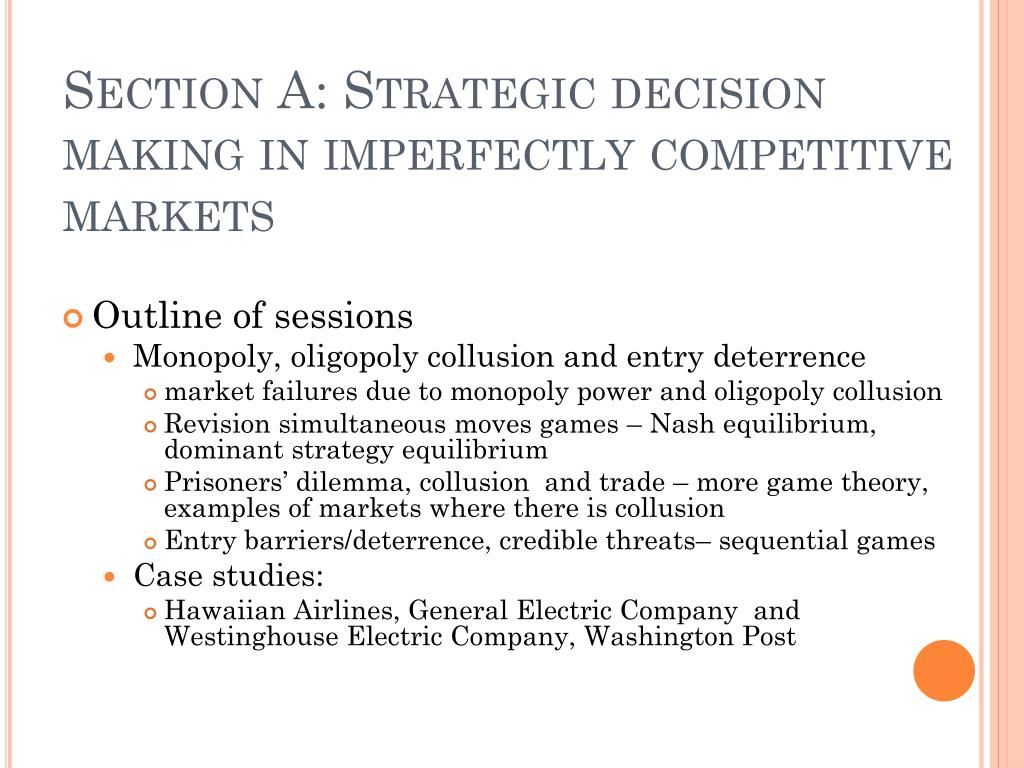
  1. Section A: Strategic decision making in imperfectly competitive markets • Outline of sessions • Monopoly, oligopoly collusion and entry deterrence • market failures due to monopoly power and oligopoly collusion • Revision simultaneous moves games – Nash equilibrium, dominant strategy equilibrium • Prisoners’ dilemma, collusion and trade – more game theory, examples of markets where there is collusion • Entry barriers/deterrence, credible threats– sequential games • Case studies: • Hawaiian Airlines, General Electric Company and Westinghouse Electric Company, Washington Post

  2. Suggested reading • For the theory and the business applications: • Allen et al. 2007. Managerial Economics 7th edition. Norton. Parts 4 and 6 • Kreps, D. M. 2004. Microeconomics for Managers. Norton. Chapters 21-23 • Frank, R. H. 2008. Microeconomics and behaviour. McGraw Hill. Chapters 12-13 • Wall,S., Minocha, S. and Rees, B. 2010. International Business, Pearson. Chapter 7 • Dixit, A., Reiley, D. H. and Skeath, S. 2009. Games of Strategy, 3rd Edition , Norton • Rasmusen, E. 2007. Games and Information, Blackwell. Chapters 1-2, 4-5 • Carmichael, F. 2004. A Guide to Game Theory, Pearson. Chapters 1-4, 7-8 • For the league sports application: • Grimes, P, Register, C. and Sharp, A. 2009. Economics of Social Issues, McGraw Hill. Chapter 9 • Plus sports economics texts of which there are many e.g. Sandy, Sloane and Rosentraub, The Economics of Sports, Palgrave. Chapters 1-6

  3. Objectives • By the end of section A you should be able to: • Explain why collusion between firms is in general likely to be undesirable from the perspective of consumers. • Explain why game theorists predict that collusion between oligopolists is likely to be fragile unless there is some possibility of repetition in the longer term and/or a large ‘swing’ producer or collusion is in the interests of consumers. (Collusion) • Use game theory to explain what is implied by a credible threat to fight the entry of a new firm into an industry. Use your analysis to show how an incumbent monopolist (or oligopolistic cartel) might be able to deter entry even though fighting entry is costly. (Entry barriers and entry deterrence) • Use case studies to illustrate how firms collude, erect entry barriers and fight entry and to explain the idea of a credible threat.