CIVIL WAR & RECONSTRUCTION
Explore the significant forces of Manifest Destiny and westward expansion in U.S. history. This chapter delves into the idea that God granted Americans the continent, driving massive movements westward to the Pacific. Key events like the Oregon Trail, the Texas struggle for independence, and the Mexican-American War delineate the tensions that arose from this expansion, including issues surrounding slavery and territorial governance. The chapter concludes with an analysis of socio-political divisions leading to the Civil War, providing a comprehensive overview of a pivotal era in American history.

CIVIL WAR & RECONSTRUCTION
E N D
Presentation Transcript
CIVIL WAR & RECONSTRUCTION U.S. HISTORY & GEOGRAPHY CHAPTER 1 LESSONS 4 – 5
MANIFEST DESTINY • Idea that god had bestowed the entire continent to the Americans • Caused massive expansion west to Pacific Ocean & Mexican Territory • Santa Fe Trail – Independence, MO to Santa Fe, NM • Oregon Trail – Independence, MO to Portland, OR • Church of Jesus Christ of Latter-day Saints (Mormons) - Utah
Joseph Smith Brigham Young
OREGON & TEXAS • Oregon territory divided on 49th parallel between Britain & U.S. Creates WA, OR, ID • Mexico gains independence from Spain. Offers land to American farmers • American farmers want to be part of U.S. Mexico refuses to sell TX • Stephen Austin attempts to settle things only to be imprisoned by Antonio Lopez de Santa Anna • Battle of Alamo – 187 killed, few women & children survived • Sam Houston defeats Santa Anna. • Forms Republic of Texas “The Lone Star Republic”
Stephen Austin The Alamo Sam Houston Antonio Lopez de Santa Anna
WAR WITH MEXICO • President Polk supports TX & sends General Zachary Taylor to defend it • American blood spilt on American soil. • American forces capture Mexican cities • Colonel Stephen Kearny & John C. Fremont claim New Mexico & the Republic of California where they hoisted a flag that featured a grizzly bear • Zachary Taylor captures Monterrey, Mexico. Winfield Scott captures Veracruz & Mexico City James Polk Zachary Taylor John Slidell
WAR WITH MEXICO • Treaty of Guadalupe Hidalgo: Rio Grande is border for TX, NM & CA go to U.S. $15 million paid for south CA, NV, NM, UT, AZ, CO, & WY • Gadsden Purchase: current borders for lower 48 states • Wilmot Proviso: slavery should not exist in any territory acquired from Mexico. Favored by Northerners
SLAVERY & WESTWARD EXPANSION James Marshall • Popular Sovereignty • California Gold Rush – skips territorial phase & push to be admitted as a state • Compromise of 1850: CA = free, South = Fugitive Slave Law, BOTH = popular sovereignty • Fugitive Slave Act: easier to capture runaways; assisting alleged fugitives = $1k fine, imprisonment for 6 months, or both
SLAVERY & WESTWARD EXPANSION • Underground Railroad • Harriet Tubman – slave conductor • Harriett Beecher Stowe – Uncle Tom’s Cabin • Stephen A. Douglas – offers each provision of Compromise of 1850 separately & they pass
CRISIS OF KANSAS • Douglas wants to build a railroad but needs to get Nebraska Territory admitted to union. Willing to repeal Missouri Compromise • Kansas-Nebraska Act: two states – NE & KS; popular sovereignty rule in effect to decide slavery issue • Proslavery vs. Anti-slavery in KS – voting fraud • “Sack of Lawrence” • John Brown – abolitionist; Pottawatomie Massacre
POLITICAL & SECTIONAL DIVISIONS • Charles Sumner’s vs. Senator Butler, SC – SEE POLITICAL CARTOON PG. 60 • Whig party divided on slavery issue • American Party: anti-Catholic, “Know-nothing” party, divided on slavery • Free-Soil Party: opposed expansion of slavery • Liberty Party: abolitionists who wanted slavery ended by passing laws • Republican Party: antislavery Democrats, discontented Northern Whigs, & Free-soilers.
DRED SCOTT V. SANDFORD • Dred Scott is a slave who sued for freedom as his owner died & he lived for 4 years in IL • Supreme Court Chief Justice Roger Taney’s decision: • Scott was not a citizen, but property • Missouri Compromise is unconstitutional as it violated citizen’s rights under 5th amendment
UNION DISSOLVES • John Brown attempts to arm slaves to end slavery by raiding Harper’s Ferry • Lincoln-Douglas debates – 6 debates all on issue of slavery
UNION DISSOLVES • Freeport Doctrine: any territory could exclude slavery by simply refusing to pass laws supporting & enforcing them • Lincoln wins the presidential election of 1860 • Secession: Southern states leave the union beginning with SC. Followed by MI, FL, AL, FA, LA, & TX • Confederate States of America (Confederacy) is formed
UNION ADVANTAGES • Strong naval tradition • Industrialization - factories • Railroads • Instant communication – telegraph • Immigrants providing labor • Population • Food production
CONFEDERACY ADVANTAGES • Strong military leadership – first rate generals • Rivers for transportation • Profit from cotton • Motivated soldiers defending homeland
Lincoln FORT SUMTER • Lincoln’s dilemma: reinforce it or retreat. • Jefferson’s dilemma: do nothing or attack the fort • Sumter is attacked on April 12, 1861 • VA secedes from Union after Sumter’s fall • Richmond becomes capital of Confederacy • May 1861: AS, TN, & NC secede • MD, KY, DE, MI remain in Union but many will fight for Confederacy Jefferson Davis
FIRST BATTLE OF BULL RUN • Union’s Plan (Anaconda Plan): blockade of southern ports, control of Mississippi River, & capture Richmond • Bull Run (Manassas Junction): July 21, 1861. • Both sides were inexperienced • Total chaos for Union • Lincoln appoints George McClellan to lead the Army of the Potomac
An 1861 cartoon map illustrating Gen. Winfield Scott’s Anaconda plan. Credit: Library of Congress Geography and Map Division Washington, D.C. (Digital File Number: g3701s cw0011000
First Bull Run General Thomas “Stonewall” Jackson - Confederacy
WAR IN THE WEST • General Ulysses S. Grant: captures Fort Henry (TN River), Fort Donelson (Cumberland River), & Shiloh. Grant only accepts unconditional surrender • David Farragut: seizes New Orleans, Baton Rouge, & Natchez. • Ironclads: metal ships. Monitor (Union) vs. Merrimack (Confederacy) ends in a stalemate
WAR IN THE EAST • Seven Days’ Battle – June 25 to July 1, 1862: Lee defends Richmond from McClellan • Second Battle of Bull Run – Aug. 29/30, 1862: Lee moves against Washington D.C. • Battle of Antietam – Sept. 17, 1862: bloodiest single day. Over 26k died. McClellan would be fired for not chasing Lee’s battered men General Robert E. Lee
Sunken Road Photos taken by Matthew Brady
EMANCIPATION PROCLAMATION • Lincoln disliked slavery but did not believe govt. could abolish it where it already existed • Lincoln uses constitutional war powers to institute proclamation • Emancipation Proclamation: • Goes into effect January 1, 1863 • Only applied to areas BEHIND Confederate lines, outside Union control • Allows for free blacks to serve Union army (Massachusetts 54th)
THE POLITICS OF WAR • Trent Affair: attempt by South to “test” Britain’s neutrality & to gain their assistance. Captain Charles Wilkes (Union) arrested James Mason & John Slidell (Confederate) who were aboard a British ship Trent. Britain moved 8K troops to Canada. Lincoln freed the men stating that Wilkes acted without orders. James Mason Capt. Charles Wilkes John Slidell
POLITICAL OF WAR • Lincoln deals with dissent by: • suspending habeas corpus rights • Seizes telegraph offices • Davis would deal with dissent in the same manner • Conscription riots plagued both Union & Confederacy
AFRICAN AMERICANS • North: Former slaves would serve Union army (Massachusetts 54th); still suffer discrimination • Fort Pillow, TN: Confederates massacred over 200 African American prisoners & whites who were with them • South: considered drafting them; they would engage in sabotage
ECONOMIC CONDITIONS DURING THE WAR • South: plantation system weakened; shortages in manpower, food-growing causing food prices to rise, loss of slaves, Union blockade of ports • North: industries boomed, corruption in industry, work force of whites dwindled but they would be replaced by African Americans & women, wages did not keep up with cost of living
TURNING POINTS OF THE WAR • May 1863: Lee defeats the North at Chancellorsville. General Thomas “Stonewall” Jackson is shot by accident by Confederate soldiers, loses his left arm, & later dies of Pneumonia on May 10. Lee continues to press onward into Gettysburg, PA.
TURNING POINTS OF THE WAR • Vicksburg • a year long siege • surrenders on July 4, 1863
TURNING POINTS OF THE WAR • Gettysburg: 3 full days of fighting. Starts July 1, 1863. Fighting finally stops & on July 4 the dead are accounted for • Day 1: Confederates go into town looking for shoes run in John Buford’s cavalry. Confederates take the town • Day 2: Confederates attack Cemetery Ridge from Seminary Ridge going through orchard & wheat field. Huge loss of life. Union takes control of Little Round Top • Day 3: artillery barrages for most of morning. Lee advances during silence. Lee retreats
TURNING POINTS OF WAR • Total loss of life at Gettysburg: • North – 23k killed or wounded • South – 28k killed or wounded • Gettysburg Address: November 1863 • land dedicated to soldiers who died. Over 100 are still not identified • Lincoln’s 10-minute speech where he focuses on the U.S. as a WHOLE & defined what the U.S. IS
THE WAR ENDS • Ulysses S. Grant appointed over Potomac Army • “Wilderness” Campaign • “March to the Sea” • Lincoln wins second term • Petersburg, VA – final battle • Appomattox Courthouse – Lee surrenders on April 9, 1865
“March to the Sea” William Tecumseh Sherman
RESULTS OF WAR • Political: • Government exerts national authority • Secession never used again • Income tax • Currency • Conscription • State’s rights exerted in other forms • Economic: • National railroad • Federal Banks • North: profit, $ to invest, new technology • South: 40% of livestock gone, lack of farm machinery, railroads destroyed, uncultivated land
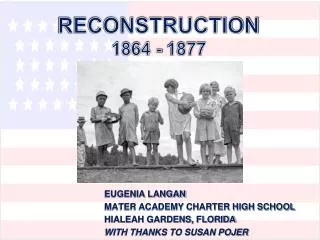
RECONSTRUCTION • 1865 – 1877 – refers to rebuilding of the South & readmission of Confederate States • Lincoln’s 10% plan • Pardon for all Confederate soldiers except high-ranking ones as long as they sword allegiance to Union • Once 10% did this then state could reform government & gain representation in U.S. Congress
RECONSTRUCTION • “Radical” Republicans opposed Lincoln’s plan. Believed that Reconstruction belonged to Congress. • Wade-Davis Bill – puts Reconstruction in hands of Congress. Lincoln uses “pocket” veto Charles Sumner Thaddeus Stevens