Understanding Photosynthesis: Processes and Structure of Chloroplasts
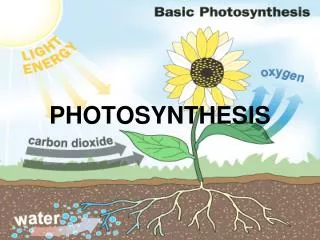
Photosynthesis is a critical biological process where autotrophs, such as plants, convert carbon dioxide and water into glucose and oxygen using light energy. This process occurs in chloroplasts, which contain intricate structures and membranes that facilitate light capture and energy conversion. Key reactions include light-dependent reactions, which produce ATP and NADPH, and the Calvin cycle, which utilizes these products to fix CO2 into sugar. The evolution of metabolic pathways, including the role of various pigments like chlorophyll, is essential for efficient photosynthesis and energy transfer.

Understanding Photosynthesis: Processes and Structure of Chloroplasts
E N D
Presentation Transcript
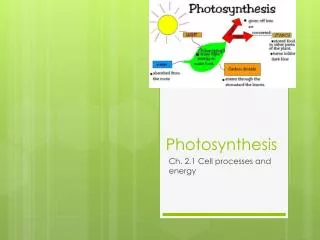
Photosynthesis • Heterotrophs: depend on external C sources (e.g. animals) • Autotrophs: can survive on CO2 as sole C source (e.g. plants, etc) • Requires large E input • Chemoautotrophs: use E in inorganic chemical compounds (e.g. NH3, etc) • Photoautotrophs: use E in light E = hc / • Shorter wavelength = higher energy photon • Evolution of modern metabolic pathways • Initial CO2 atmosphere 1. Heterotrophs (anaerobic) 2. Chemoautotrophs (anaerobic) 3. Photoautotrophs: CO2 + H2O --> CH2O + O2 • O2 atmosphere, aerobic metabolism evolved • Symbiotic bacterium --> --> --> modern mitochondrion • Symbiotic cyanobacterium --> --> --> modern chloroplast
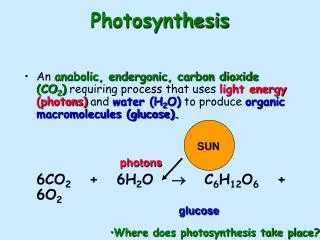
Photosynthesis • The photosynthetic redox reaction: 6H2O + 6CO2 --> C6H12O6 + 6O2 weak reducer + weak oxidizer --> strong reducer + strong oxidizer • E = hc / @ = 680nm, E = -42 kcal/mol photons ( ~ 6 ATP)
Photosynthesis • Chloroplast structure and function • Membranes • Outer: permeable to many things • Porins, large central pore • Inner: highly impermeable • Specific channels for certain molecules
Chloroplast structure and function • Membranes • Thylakoid membrane system • Contained within the inner membrane system • Arranged in stacks: Grana • Enzymes for light capture are embedded within this membrane • Photosystem II (PSII) • Cytochrome b6f (like ETC Comp. III) (move protons) • Photosystem I (PSI) • ATP synthase
Chloroplast structure and function • Enclosed spaces • Intermembrane space: between outer and inner membranes • Stroma: space enclosed by inner mem. • Contains the thylakoids • Contains the Calvin cycle enzymes for CO2 fixation into sugar • Contains DNA, ribosomes • Lumen: Space enclosed by thylakoids • Accumulates high [H+] for ATP synthesis by ATP synthase Stroma stroma lumen
Photosynthesis • The photosynthetic reaction H2O + CO2 --> CH2O + O2 • For a long time, the O2 released was thought to come from CO2 (wrong) • Studies on sulfur bacteria showed: H2S + CO2 --> CH2O + 2S • So van Niel postulated a generic scheme: H2X + CO2 --> CH2O + 2X • And it was later shown that indeed the O2 comes from H2O 6H2O + 6CO2 --> C6H12O6 + 6O2 weak reducer + weak oxidizer --> strong reducer + strong oxidizer
Light dependent reactions • Capture E of light into ATP and NADPH • Produce O2 from H2O • Light independent reactions • Use ATP and NADPH to capture and reduce CO2 into sugar • Plants also use aerobic respiration (mitochondria)
Absorption of light • Photon is absorbed by a molecule • ‘pushes’ an electron from an inner (lower E) to an outer (higher E) orbital e- + photon --> e* (excited state) • # orbitals is finite and E levels are specific • Different molecules can only absorb photons of certain E (wavelength)
Photosynthetic pigments • Chlorophyll • Beta-carotene • Conjugated systems • Alternating single and double bonds • Delocalized electron cloud • Can absorb more varied wavelengths • Strong absorbers of visible light
Photosynthetic units • 100s of chlorophyll molecules • Noncovalent link to thylakoid membrane (Light Harvesting Complexes) • Group acts as an antenna for light • Photon is passed around • each pass reduces E (wavelength longer) • Only one is the reaction-center • P680, PSII • P700, PSI • Transfers e* to a carrier
H2O + NADP+ --> 1/2O2 + NADPH + H+ Eo’ = 1.14V In cell, need ~ 2V Cell uses 2 photons, in 2 steps • Photosynthetic units • Photosystem II (PSII) • Boost e* halfway to NADP+ • Photosystem I (PSI) • Boost e* above NADP+
Photosystem II • 20 subunits, embedded in thylakoid membrane • Associated with Light Harvesting Complex II (LHCII) • Antenna pigments (chlorophyll) + protein subunits • Light absorbed into D1/2 complex, e* transfer to Pheophytin P680* + Pheo --> P680+ + Pheo-(charge separation)
P680* + Pheo --> P680+ + Pheo-(charge separation) • P680+= strong oxidizing agent (most powerful in biology) • Will accept e- from H2O and yield O2 in process (photolysis) • Pheo-= strong reducing agent • Will pass e- to Plastoquinone (PQ) --> PQH2
Cytochrome b6f (structure-function similarity to Complex III) • Accepts 2e- from PQH2 • Translocates 4H+ per pair of e- • Transfers e- to Plastocyanin protein (PC) • PC carries e- to PSI
Photosystem I (PSI) • LHCI • Contains light antenna • P700 rxn center P700* + A0 --> P700+ + A0- • P700+ receives e- from PC • A0- txfr e- to ferredoxin (Fd) • Fd donates e- to: NADP+ + H:- --> NADPH Fd NADP+ reductase (FNR)
Light reactions summary 2H2O + 2NADP+ + 2H+ + 8photons --> O2 + 2NADPH Also, 18H+ difference generated across thylakoid membrane • Acidic inside lumen ATP synthase can generate ~ 5 ATP
Noncyclic versus cyclic photophosphorylation • Noncyclic: passage of e- from H2O to NADP+ yielding H2O and NADPH plus, the proton gradient for ATP synthase • Cyclic: Fd passes e- to cytochrome b6f instead of Fd NADP+ reductase creates proton gradient, but no NADPH • ATP synthesis can be uncoupled from NADPH synthesis
Light independent rxns: Calvin cycle • Key step: Ribulose bisphosphate carboxylase (RuBisCo) • 5C + CO2 --> 2x 3C (3-phosphoglycerate from glycolysis) • Plants that fix CO2 this way are called C3 plants because of the 3C intermediate 6CO2 + 18ATP + 12NADPH --> Fructose + 18ADP + 12NADP+ + 18Pi • Calvin cycle enzymes are in the stroma
Light independent rxns: Calvin cycle 6CO2 + 18ATP + 12NADPH --> Fructose + 18ADP + 12NADP+ + 18Pi
Light independent rxns: Calvin cycle • Many steps are actually light sensitive • Redox control: in absence of light, enzymes become inactivated • Transfer e- from Fd to Thioredoxin • Reduce disulfide bridges in proteins for light-dependent regulation of activity: R-S-S-R(inactive) + 2e- + 2H+ --> R-SH(active) + R-SH(active)
Photorespiration • RuBisCo is at the mercy of the [CO2]/[O2] ratio • Rise in global [CO2] likely linked to increased crop yields • 270ppm(1870) --> 380ppm(now) • Only modest preference of enzyme for CO2 glycolate CO2 release
Hot dry climates are hard on C3 plants • Must shut stomata to prevent H2O loss during day • Also keeps CO2 out (and O2 builds up inside = photorespiration problem) • C4 plants use PEP carboxylase enzyme • PEP (3C) + CO2 --> OA (4C) PEP carboxylase works at much lower [CO2], open stomata less often!